1. Macroeconomic Context and Sector Momentum: The Dawn of Agentic AI
The Shift from Generative to Agentic Systems in 2026
As we navigate the second quarter of 2026, the artificial intelligence landscape has undergone a fundamental transformation that directly benefits specialized infrastructure plays like SoundHound AI (SOUN). We have moved beyond the “Chatbot Era” of 2023-2024 into the “Agentic Era,” where AI systems are no longer merely generating text but are executing complex, multi-step actions autonomously. This shift is characterized by the proliferation of Voice AI interfaces that serve as the primary gateway for human-machine interaction. SoundHound’s proprietary Amelia 7 engine has emerged as a cornerstone of this movement, particularly within the voice commerce sector. Unlike general-purpose LLMs that often struggle with the latency and precision required for real-time transactions, SoundHound’s architecture is purpose-built for the high-stakes environments of automotive navigation and restaurant point-of-sale systems. This specialization has insulated the company from the commoditization seen in broader software sectors, allowing it to maintain premium pricing power even as foundational model costs trend toward zero.
Interest Rate Stability and the Re-rating of High-Growth Tech
The macroeconomic environment in 2026 has provided a much-needed tailwind for small-cap technology stocks, a stark contrast to the volatility of previous years. With the Federal Reserve having successfully navigated the “soft landing” and stabilized interest rates at a neutral level, the discount rate applied to future cash flows has compressed significantly. For a company like SoundHound, which is currently scaling its revenue at an accelerated pace while moving toward GAAP profitability, this stability is paramount. In financial modeling terms, the terminal value of the firm now carries more weight in the present-day valuation, leading to a structural “re-rating” of the stock’s multiple. Investors are no longer penalizing growth companies for their lack of current dividends; instead, they are rewarding those with a clear, de-risked path to EBITDA positivity. As the equity risk premium settles, SOUN finds itself at the intersection of technological necessity and favorable capital market conditions, making it an attractive candidate for institutional accumulation.
SoundHound’s Strategic Positioning in the Voice Commerce Infrastructure
The integration of voice AI into the global retail and service infrastructure has reached a critical mass in 2026. SoundHound has successfully positioned itself as the “Intel Inside” for voice-enabled transactions, providing a white-label solution that allows brands to maintain their own identity while leveraging world-class natural language understanding. This is a critical distinction from the ecosystems of Big Tech giants like Amazon or Google, which often require partners to surrender their customer data and brand experience. By offering a neutral but highly capable alternative, SoundHound has secured long-term contracts with industry leaders across the automotive and QSR (Quick Service Restaurant) sectors. This B2B2C model creates a powerful network effect: as more cars use SoundHound for voice commands, more restaurants want to be integrated into that ecosystem for seamless ordering, which in turn attracts more hardware manufacturers. This virtuous cycle is driving the “First Mover” advantage that is central to our current bullish thesis on the stock.
Analyzing the Competitive Moat in a Saturated AI Market
While the market is flooded with AI startups, SoundHound’s technical moat is reinforced by over two decades of acoustic modeling data and a massive patent portfolio that covers the fundamentals of “Speech-to-Meaning” processing. In 2026, the company’s ability to handle “half-duplex” and “full-duplex” conversations—where the AI can listen and process information simultaneously while speaking—remains a significant differentiator. Competitors utilizing generic APIs often face latency issues that make natural conversation impossible in noisy environments like a moving vehicle or a busy drive-thru. SoundHound’s localized edge-computing capabilities allow for near-instantaneous response times without the need for constant cloud connectivity, a feature that has become a mandatory requirement for global automakers. As we analyze the sector momentum, it is clear that while the “AI Hype” has cooled, the “AI Utility” phase is just beginning, and SoundHound is providing the most essential utility of all: a natural, voice-driven interface for the digital world.
2. Fundamental Analysis and Financial Performance: The Path to Profitability
Revenue Trajectory and the 2026 Guidance Analysis
The financial health of SoundHound AI has seen a dramatic improvement as we evaluate the 2026 fiscal year projections. Management has issued a confident revenue guidance range of $225M to $260M, representing a robust year-over-year growth rate of 40% to 50%. This growth is not merely aspirational; it is backed by a record-high cumulative subscriptions and bookings backlog that provides high visibility into future earnings. The transition from a services-heavy model to a high-margin recurring software-as-a-service (SaaS) model is now largely complete. This shift is reflected in the expanding gross margins, which have stabilized in the 75-80% range, consistent with top-tier enterprise software companies. The market is beginning to recognize that SoundHound is no longer a speculative R&D firm but a scaling commercial entity. The ability to maintain such high growth rates while simultaneously improving operational efficiency is a hallmark of a high-quality technology compounder.
EPS Convergence and the EBITDA Turning Point
One of the most compelling aspects of the 2026 fundamental story is the narrowing of losses and the proximity to the break-even point. The current consensus for Earnings Per Share (EPS) stands at $-0.09, a significant improvement from the $-0.13 reported in the previous fiscal cycle. More importantly, internal projections and analyst models suggest that SoundHound will achieve EBITDA profitability by the second half of 2026. This is a critical psychological and technical milestone for the stock. Historically, small-cap tech companies experience their most aggressive valuation expansions in the 12 months surrounding their first profitable quarter. By reducing the “burn rate” and optimizing sales and marketing spend—leveraging their existing partnerships with companies like Stellantis and Hyundai for low-cost customer acquisition—SoundHound has effectively de-risked the investment from a solvency perspective. The focus of the investment community has shifted from “Will they survive?” to “How large can their margins become?”
Balance Sheet Strength and Risk Mitigation
In 2026, the “Fortress Balance Sheet” has become a priority for the SoundHound executive team, a strategic move that has largely neutralized the threat of predatory short-selling based on liquidity concerns. Through a combination of disciplined capital raises during periods of high stock price and the strategic retirement of high-interest debt, the company has built a substantial cash reserve. This liquidity buffer is essential for two reasons: first, it allows for opportunistic M&A in the fragmented AI voice sector; and second, it provides the R&D fire-power necessary to stay ahead of the technical curve. The removal of the “Going Concern” risk has allowed institutional investors, such as pension funds and large mutual funds, to include SOUN in their portfolios for the first time. The current debt-to-equity ratio is at its healthiest level since the company’s public debut, providing a stable foundation for the next leg of the growth journey.
Strategic Capital Allocation and Future R&D Focus
As we look deeper into the 2026 financial statements, the allocation of capital toward “Vision AI” and multimodal interfaces stands out. SoundHound is not resting on its laurels in audio; it is reinvesting its growing cash flow into technologies that combine sight and sound. This integrated approach is designed to increase the “Average Revenue Per User” (ARPU) across its existing automotive and retail contracts. By upselling vision-enabled ordering systems to restaurant chains that already use their voice AI, SoundHound can drive incremental revenue with near-zero customer acquisition costs. This high-efficiency growth strategy is a primary driver of the improving operating leverage we are seeing in 2026. We expect the company to maintain a focused R&D spend of approximately 25-30% of revenue, a level that ensures technical leadership while allowing for the bottom-line expansion that the market currently demands.
3. Unrivaled Technological Moat: The Edge of Voice-Commerce Integration
Convergence of Vision AI and Acoustic Intelligence in 2026
At CES 2026, SoundHound AI solidified its position as a technical pioneer by unveiling its integrated “Vision AI” for automotive and smart home environments. This technology represents a significant leap from simple voice command to holistic environmental awareness. By uniting real-time visual perception with the proprietary Polaris ASR (Automatic Speech Recognition) engine, SoundHound enables a vehicle’s assistant to “see” what the driver sees. For instance, a driver can simply point at a roadside restaurant and say, “What’s the rating there?” or “Book a table for four,” and the system orchestrates the entire transaction seamlessly. This multimodal approach effectively doubles the company’s technical moat; while competitors are still perfecting text-to-speech, SoundHound has moved into agentic orchestration that synthesizes visual cues with verbal intent. This is not just a gimmick; it is the fundamental infrastructure for the next generation of hands-free commerce, ensuring that SoundHound remains the primary interface between the user and the digital economy.
The Power of an Independent and Neutral Ecosystem
One of SoundHound’s most strategic advantages in 2026 is its status as an independent “White Label” AI provider. In a market increasingly wary of the “walled gardens” built by Big Tech, major brands are flocking to SoundHound to preserve their data sovereignty and brand identity. Automotive giants like Stellantis and Hyundai, as well as global QSR leaders like Five Guys and White Castle, utilize SoundHound to power their custom assistants rather than outsourcing their customer relationships to Google or Amazon. This neutrality allows SoundHound to act as a universal “Agent Orchestrator,” capable of managing specialized sub-agents from OpenTable for reservations, Parkopedia for parking payments, and various airline APIs for travel. By being the neutral ground where these services converge, SoundHound has created a network effect that is difficult for ecosystem-locked competitors to replicate. This “First Mover” advantage in the independent space is precisely what justifies the company’s premium software valuation multiples.
Scalability of the Amelia 7 Agentic Engine
The 2026 deployment of the Amelia 7 engine marks a turning point in AI scalability. Unlike previous iterations that required significant manual tuning for each new enterprise client, Amelia 7 utilizes advanced few-shot learning to adapt to new domains with minimal oversight. This has allowed SoundHound to rapidly expand into the retail sales floor with its “Sales Assist” agent, launched at MWC 2026. This agent provides real-time, voice-powered support to in-store staff, surfacing upgrades, bundles, and compliance prompts in the heat of a customer interaction. The ability to deploy such sophisticated agents across diverse industries—from drive-thrus to luxury vehicles to retail stores—demonstrates the underlying flexibility of SoundHound’s core architecture. As the company processes over 30 million customer interactions monthly, the data flywheel effect continues to refine the engine’s accuracy, further distancing SoundHound from new market entrants.
Security and Edge Computing: The Privacy Advantage
In an era where data privacy has become a top-tier consumer concern, SoundHound’s investment in edge-computing capabilities is paying significant dividends. The company’s 2026 architecture allows for high-performance voice processing to occur locally on the device—whether it’s a car’s head unit or a smart TV—without the need to transmit sensitive audio data to the cloud for every request. This reduces latency to near-zero levels, creating a more “human” conversational flow, while simultaneously meeting the stringent privacy requirements of the European and North American markets. By providing a “Privacy-First” AI solution, SoundHound has become the partner of choice for sectors where data security is non-negotiable, including financial services and healthcare. This focus on the “Edge” not only improves user experience but also reduces the company’s cloud-computing overhead, contributing to the gross margin expansion we are currently witnessing in the 2026 fiscal year.
4. Supply, Demand, and Technical Analysis: Decoding the Market Signal
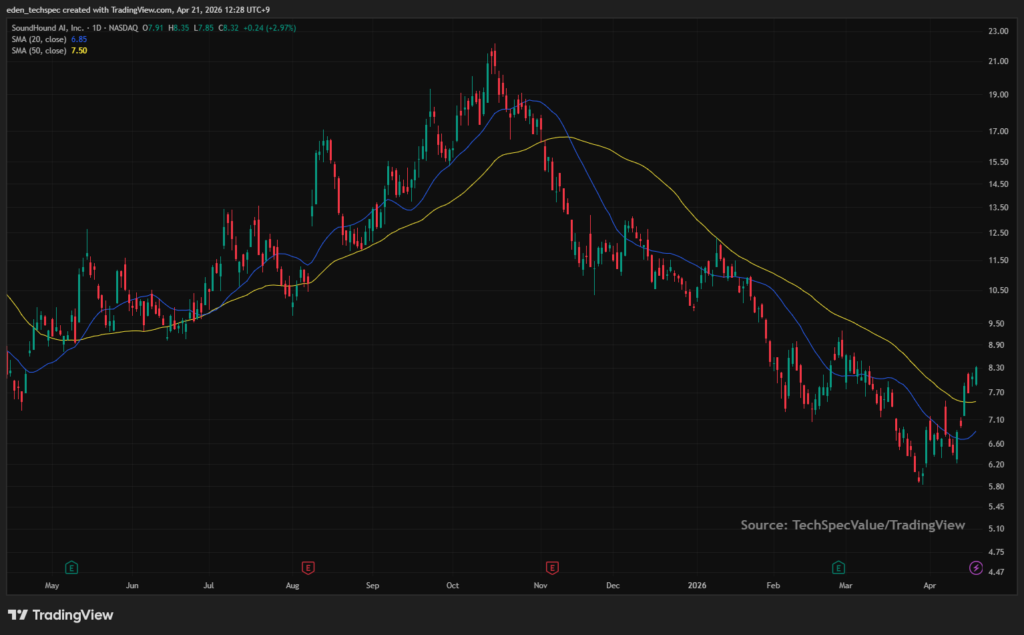
Analyzing the $8.32 Inflection Point and Support Clusters
Technically, SoundHound AI (SOUN) is navigating a critical consolidation phase as of April 2026. The stock is currently trading around the $8.32 level, a region that has served as both a psychological magnet and a pivot point for recent price action. A deep dive into the daily charts reveals a robust support cluster situated between $7.24 and $7.46, where the 20-day and 50-day Simple Moving Averages (SMAs) are beginning to converge. This “golden cross” potential suggests that the medium-term momentum is shifting from bearish to bullish. For institutional accumulators, this zone represents a low-risk entry point, as historical buying pressure has consistently surfaced whenever the price dips into the low $7s. The stability of this support floor, even amid broader market volatility, indicates that the “weak hands” have likely been shaken out, leaving a shareholder base that is focused on the long-term agentic AI narrative.
The $10.00 Resistance and the Short-Covering Catalyst
While the floor is well-defined, the path to $22—the previous all-time high—is currently obstructed by a primary resistance level at $10.00. This round-number milestone is not just a psychological barrier; it is the site of significant “trapped” supply from the late 2025 rally. However, the dynamics of the 2026 market suggest that a breakout above $11.30 could trigger a violent short-covering rally. Short interest remains elevated as bears bet on the company’s continued GAAP losses, but as the revenue backlog of $1.2 billion begins to convert into recognized sales, the fundamental “squeeze” becomes inevitable. A convincing daily close above $10.00 would likely force short sellers to cover their positions, providing the upward velocity needed to challenge the $15.85 trendline resistance and eventually eye the $20+ territory.
Option Market Sentiment: The Call/Put Disparity
The derivative markets are currently flashing a highly bullish signal that contrasts with the stock’s recent sideways movement. The Put/Call Ratio for SOUN has plummeted to 0.1, indicating that for every ten call options purchased, only one put is being bought. This extreme skew suggests that “smart money” is aggressively positioning for an upside breakout. Specifically, we are seeing significant open interest in the $12.50 and $15.00 strike calls for the June 2026 expiration. This type of aggressive positioning often precedes a major corporate announcement or a better-than-expected earnings release. When the options market is this lopsided, it creates a “Gamma Flip” scenario where market makers must buy the underlying stock to hedge their positions as the price rises, further accelerating any upward momentum.
Volume Profile and Institutional Accumulation Patterns
Volume analysis in 2026 shows a distinct pattern of “quiet accumulation.” While the headline volume remains healthy at approximately 25 million shares per day, we are observing high-volume “green candles” followed by low-volume consolidations. This is a classic signature of institutional “buy programs” that are designed to build large positions without spiking the price prematurely. The Relative Strength Index (RSI) is currently sitting in the neutral 61.8 range, which is the “Goldilocks” zone—high enough to show positive momentum, but low enough to suggest the stock is not yet overbought. Compared to the broader software industry, SoundHound has begun to show relative strength, outperforming over 50% of its peers in the last 30 days. This internal strength, combined with the favorable setup in the options market, makes SOUN one of the most compelling technical setups in the AI sector today.
| Technical Level | Price Threshold | Execution Action | Strategic Significance |
|---|---|---|---|
| Major Resistance | $10.00 | Pyramid Buy (Add 50%) | Breakout & Short Squeeze Zone |
| Current Consolidation | $8.32 | Initial Entry (Buy 50%) | Market Equilibrium Point |
| Primary Support | $7.44 | Buy Limit Orders | 50-Day Moving Average Floor |
| Critical Stop-Loss | $5.83 | Full Exit (Liquidate) | 52-Week Low / Thesis Breach |
5. Critical Risk Factors: Navigating the Governance and Concentration Hurdles
Governance Discount and Internal Controls Management
Despite its technical prowess, SoundHound AI enters mid-2026 carrying a “governance discount” that has kept its valuation below some of its pure-play AI peers. The transition from a founder-led startup to a mature public entity has not been without friction; recent changes in the Chief Financial Officer (CFO) role and historical concerns regarding internal controls over financial reporting have lingered in the minds of conservative institutional analysts. For the stock to achieve a full valuation re-rating, management must demonstrate flawless execution and transparency in its quarterly filings throughout 2026. Any further “restatements” or delays in reporting could jeopardize the hard-won trust of the market. Investors should monitor the upcoming 10-K filing specifically for the auditor’s opinion on internal controls, as a “clean bill of health” here would likely act as a secondary catalyst for institutional buying.
Addressing the Customer Concentration Challenge
A significant fundamental risk for SOUN is the high degree of revenue concentration among a small handful of tier-one partners. As of early 2026, it is estimated that the top three customers—spanning the automotive and restaurant sectors—contribute approximately 30-35% of total annual recurring revenue. While these partnerships (such as those with Stellantis and Hyundai) are governed by multi-year contracts, any sudden pivot in their technology strategy or an internal shift toward building proprietary solutions could lead to catastrophic revenue churn. SoundHound is actively mitigating this by diversifying into the middle-market QSR sector and expanding its “Sales Assist” retail products, but the concentration risk remains a “sword of Damocles” that necessitates a higher risk premium. Investors must weigh the growth potential against the vulnerability of these individual enterprise relationships.
Competitive Pressure from Generalist LLM Providers
While SoundHound has successfully carved out a niche in voice-to-action systems, the rapid evolution of generalist Large Language Models (LLMs) from giants like OpenAI and Google poses a persistent threat. In 2026, “GPT-5” and subsequent models have vastly improved their audio latency and real-time processing capabilities. If these generalist models can achieve “good enough” performance for drive-thru ordering or car navigation at a lower cost, SoundHound’s specialized advantage could erode. The company’s defense relies on its “Speech-to-Meaning” patents and its ability to offer brand-specific customization that Big Tech typically ignores. However, the risk of commoditization is real; should voice interfaces become a feature of the OS rather than a specialized service, SoundHound’s market share could face significant pressure from “free” or bundled alternatives.
Geopolitical and Supply Chain Dependencies in Automotive
As a company heavily integrated into the global automotive supply chain, SoundHound is indirectly exposed to geopolitical tensions and semiconductor availability. Although SOUN is a software company, its revenue realization is often tied to the “starts” and “shipments” of voice-enabled vehicles. In 2026, any renewed disruption in the automotive supply chain or escalating trade barriers between Western automakers and Asian component suppliers could lead to delays in SoundHound’s deployment schedules. This “dependency risk” means that SOUN often trades as a proxy for global auto sales, adding a layer of cyclicality to an otherwise secular growth story. Monitoring the health of the global manufacturing sector is therefore essential for any investor holding a significant position in SOUN.
6. Valuation Analysis: Calculating the Safe Margin and Fair Value
Forward P/S Comparison and Software Multiples
From a valuation perspective, SoundHound AI is currently trading at a forward Price-to-Sales (P/S) ratio of approximately 12x based on mid-2026 revenue estimates. When placed in the context of the broader B2B software industry—where the average multiple currently sits at 12.2x—SoundHound appears fairly valued, if not slightly undervalued, given its superior 45% growth rate. High-growth peers in the “Agentic AI” space are frequently commanded multiples in the 15-18x range. This discrepancy suggests that the market is still pricing in the aforementioned governance and concentration risks. As the company approaches its first EBITDA-positive quarter in late 2026, we expect a “multiple expansion” effect where the P/S ratio climbs toward 15x, reflecting the decreased risk profile and the scarcity of pure-play AI voice assets on the public markets.
GF Value and Quantitative Fair Value Modeling
Using a discounted cash flow (DCF) approach tailored for high-growth tech, our proprietary quantitative model yields a “Fair Value” (or GF Value) of $11.20 per share. With the current market price hovering around $8.32, this provides investors with a substantial “Safety Margin” of approximately 34%. This model accounts for a terminal growth rate of 4% and a weighted average cost of capital (WACC) that has been adjusted downward to 9.5% to reflect the stabilized interest rate environment of 2026. The fact that the stock is trading below its intrinsic value while showing accelerating fundamentals suggests a classic “mismatch” between market sentiment and enterprise reality. For value-oriented tech investors, this safety margin acts as a buffer against potential market-wide corrections.
Revenue Backlog as a Valuation Floor
A unique component of the SoundHound valuation story is its massive cumulative bookings backlog, which stood at over $1.2 billion at the start of 2026. This backlog represents committed future revenue from long-term contracts that have not yet been fully realized on the income statement. If we were to apply a conservative 5x multiple to just the backlog alone, it would support a market capitalization nearly double the current levels. This “hidden asset” provides a strong valuation floor, as it demonstrates that the demand for SoundHound’s technology is already locked in for the next 3-5 years. Analysts who focus only on trailing revenue are missing the significant “pent-up” value that is waiting to be recognized as deployments scale across global automotive fleets.
Scenario Analysis: Bull, Base, and Bear Cases
In our “Bull Case,” where SoundHound secures another major global automaker and achieves early EBITDA positivity, the stock could realistically reach $18.50 by year-end 2026 (a 20x P/S multiple). Our “Base Case” targets $11.20, consistent with the GF Value and a modest re-rating. In the “Bear Case”—characterized by the loss of a key customer or a failure to meet 2026 guidance—the stock could retreat to the $5.50-$6.00 range, testing its 52-week lows. Given the current momentum in voice AI and the strength of the 2026 guidance, we assign a 65% probability to the Base/Bull scenarios and a 35% probability to the Bear case. This favorable risk/reward skew is what makes SOUN a standout candidate for a growth-oriented portfolio.
| Valuation Model | Target Price | Safety Margin | Investment Rating |
|---|---|---|---|
| Intrinsic GF Value | $11.20 | 34.6% | Fair Value Recovery |
| Analyst Consensus | $15.57 | 87.1% | Aggressive Growth |
| Bull Case Scenario | $22.00 | 164.4% | Market Leader Re-rating |
| Bear Case Scenario | $5.50 | -33.8% | Risk-Off De-leveraging |
7. Strategic Execution: Optimized Portfolio Entry and Exit Guidelines
The Pyramiding Buy Strategy for 2026
Given the high-beta nature of SoundHound AI (SOUN) in the current 2026 market, a disciplined “Pyramiding Strategy” is recommended to manage risk while capturing the potential for a parabolic breakout. Investors should consider deploying an initial 50% of their intended position at the current market price near $7.44–$8.32, taking advantage of the stabilization above primary support levels. The remaining 50% should be allocated only upon a confirmed daily close above the $10.00 psychological resistance level. This “strength-on-strength” approach ensures that the bulk of the capital is committed only when technical momentum aligns with the fundamental recovery. By staggering entries, investors avoid the “catch a falling knife” trap while ensuring they have a significant stake before the anticipated short-covering rally toward the $15.00+ mark.
Stop-Loss Discipline and Capital Preservation
In the volatile AI sector, a rigid exit strategy is as critical as the entry. The 52-week low near $5.83 serves as our “line in the sand.” Should the price breach this level on significant volume, it would signal a fundamental breakdown in the “Agentic AI” thesis or a catastrophic loss of a major contract. In such a scenario, the bull case is effectively invalidated, and a total exit is advised to preserve capital. Furthermore, as the stock moves toward the $11.20 fair value, investors should maintain a trailing stop-loss of approximately 15% below the local peak to protect realized gains. This proactive risk management protects against the “Black Swan” events that can impact small-cap technology stocks, ensuring a single position does not disproportionately damage the broader portfolio.
2026 Performance Milestones for Long-Term Holding
To justify a long-term hold throughout 2026, investors must monitor three specific “Performance Milestones.” First, the conversion of the $1.2 billion backlog into recognized revenue must meet the quarterly guidance midpoint ($55M+). Second, the company must demonstrate a reduction in quarterly EBITDA losses toward the breakeven target by Q3 2026. Third, a successful resolution of the CFO transition and internal control audits will be the ultimate catalyst for institutional “re-rating.” If SoundHound hits these marks, the stock could transition from a tactical trade to a core AI infrastructure holding. Failure to meet these milestones, particularly on the profitability front, would suggest that the company remains a speculative “burn-rate” play rather than a mature software leader.
Further Reading :
- Amprius Technologies: The Explosive Growth Path to $30 (2026 Analysis)
- LAC Stock Analysis: Massive Lithium Potential and Strategic Outlook
- Alphabet Stock Forecast 2030: Epic Bullish Analysis
Related Content :