[Macro] Macroeconomic Environmental Analysis: The Return of CPI Anxiety and Federal Reserve Leadership Transition
The Acceleration of Wholesale Inflationary Pressures and Corporate Margin Risks
The structural dynamics of the U.S. macroeconomic landscape are experiencing a pronounced period of friction, driven by persistent inflationary pressures and a historic transition within the Federal Reserve, which directly forces institutional asset allocators to completely overhaul their macro market strategy.
The April Consumer Price Index (CPI) registered a 3.7% year-over-year increase, matching consensus expectations on the surface but masking a deeper, more systemic problem for institutional asset allocators. Beneath the headline number, the Producer Price Index (PPI) surged to nearly 6.0%, acting as a leading indicator that wholesale input costs are rapidly accelerating and will inevitably pass through to consumers. According to institutional research from Bank of America (BofA), when the CPI sustains levels above the 4.0% threshold, the vulnerability of risk assets escalates exponentially.
, when these macro conditions are met, the S&P 500 has experienced an average drawdown of 4.0% over the subsequent three-month window. This data suggests that the baseline inflation rate is becoming structurally entrenched, limiting the central bank’s operational flexibility and forcing systematic asset allocators to recalibrate their risk premiums. As a result, standard equity risk premiums are expanding, and institutional desks are actively hedging against a prolonged stagflationary environment where corporate profit margins face immediate compression from rising raw material costs, altering the foundation of any long-term portfolio execution.
Central Bank Governance Transience and the Warsh Injun Trajectory
Simultaneously, the institutional framework of monetary policy is undergoing a critical pivot as Jerome Powell’s tenure officially concluded on May 15, 2026. Capital markets have trained their focus on Kevin Warsh, the leading nominee to assume the chairmanship of the Federal Reserve, parsing every legislative hearing for clues on his regulatory and monetary philosophy. While Wall Street algorithmic models have provisionally priced in a more dovish, macro-friendly liquidity guidance framework under his potential administration, ongoing dissent from hawkish regional Fed governors continues to inject severe policy uncertainty into the Treasury curve.
This leadership vacuum occurs at a highly precarious moment, as geopolitical risk vectors in the Middle East show no signs of abating. Continual maritime logistical disruptions throughout the Strait of Hormuz, exacerbated by localized drone activity, have kept a structural floor under energy benchmarks, further complicating the inflation trajectory and threatening to spark a secondary supply-side shock that could derail equity valuations. The intersection of a governance transition at the central bank and highly volatile geopolitical supply lines means that forward-looking macro guidance is virtually impossible to project with historical accuracy, leaving quantitative models highly sensitive to sudden policy shifts.
Structural Supply-Chain Disruption and Fixed-Income Volatility Escalation
The macroeconomic implications of these overlapping disruptions extend beyond simple equity valuation adjustments and are actively reshaping the fixed-income architecture. With the Producer Price Index indicating that wholesale factory-gate prices are stuck at elevated levels, fixed-income traders are aggressively repricing the terminal fed funds rate, pushing back expectations for any meaningful interest rate cuts well into the outer quarters of the year. The bond market’s volatility, tracked by the MOVE index, has surged as yield curves continue to experience erratic twisting motions, reflecting deep institutional uncertainty about the future path of real interest rates.
This environment creates a direct headwind for highly leveraged corporate issuers who must now refinance their maturing short-term obligations at significantly higher debt service costs. Furthermore, the persistence of energy-driven inflation from the geopolitical theater acts as an ongoing tax on consumer discretionary spending power, effectively draining liquidity from the retail economy. Consequently, macro portfolio managers are systematically reducing exposure to high-beta, long-duration assets that depend on cheap liquidity, instead reallocating capital into short-duration cash equivalents and highly liquid commodities that provide an organic structural hedge against a secondary wave of global supply-chain degradation.
[Sector] Sector Performance and Capital Flow Dynamics: A Technology Monopolization Within an Earnings-Driven Market
Technological Dominance, Enterprise Capex, and Semiconductor Capital Infusions
In the global equity markets, institutional capital allocation remains highly concentrated, showcasing a stark structural bifurcation where mega-cap technology corporations continue to monopolize market liquidity at the direct expense of defensive and cyclical sectors. The enterprise technology ecosystem received a massive fundamental validation following Cisco Systems’ (CSCO) latest earnings print, where the enterprise networking giant delivered a significant earnings beat accompanied by a comprehensive corporate restructuring initiative, sparking an immediate 13.0% surge in its equity value. From a systems engineering and market strategy perspective, this performance underscores a broader macroeconomic reality: corporate capital expenditure (CapEx) dedicated to foundational artificial intelligence, cloud architecture, and next-generation enterprise networking infrastructure remains highly resilient despite elevated borrowing costs.
This structural demand has directly translated into substantial capital inflows for advanced semiconductor manufacturers, particularly those exposed to high-bandwidth memory (HBM) architectures like Micron Technology (MU). These firms continue to serve as the primary operational engine driving major equity indices higher, creating an environment where fundamental earnings capacity is shielding technology valuations from rising discount rates. Consequently, quantitative fund flows show a persistent rotation into high-margin tech names, draining the broader market of breadth while concentrating index performance into a select group of hardware and software infrastructure providers.
Commodity Insulation Versus Consumer Sentiment Dislocation
Conversely, the cyclical, consumer-facing, and traditional growth segments of the economy are flashing clear, late-cycle warning signals that threaten the sustainability of this narrow market rally. While the energy sector has managed to maintain a robust technical floor due to upstream oil price support, localized drone activity, and geopolitical risk premiums within the major maritime trade corridors, consumer discretionary equities are facing severe fundamental headwinds. The University of Michigan Consumer Sentiment Index recently plummeted to historic lows, reflecting a profound sense of consumer fatigue driven by cumulative inflation, stagnant real wage growth, and elevated credit card delinquency rates.
This macroeconomic divergence creates a highly fragmented corporate landscape: while enterprise-facing technology giants possess the pricing power and cash cushions to insulate their operating margins, consumer-sensitive businesses are experiencing rapid volume contraction and margin compression. As systematic capital flows migrate away from deteriorating consumer balance sheets, liquidity is being funneled almost exclusively into high-quality, cash-generative technology moats, further intensifying the top-heavy concentration of the broader market indices and creating a dangerous dependency on a limited number of earnings reports.
| Sector Cluster | Weekly Capital Flow | Primary Macro Driver | Strategic Recommendation |
|---|---|---|---|
| Mega-Cap Tech & HBM | +$4.2B (Inflow) | Resilient AI Infrastructure & Enterprise CapEx | Concentrate in High-ROIC Moats |
| Upstream Energy | +$1.1B (Inflow) | Strait of Hormuz Disruptions & High PPI Floor | Hold as Natural Inflation Hedge |
| Consumer Discretionary | -$2.8B (Outflow) | Univ. of Michigan Sentiment Collapse & Debt Costs | Underweight; Liquidate Cyclical Beta |
[Event] The Trump-Xi Summit: Geopolitical Friction and Market Bifurcation
Initial Optimism and Historical Index Breakthroughs in Beijing
The highly anticipated bilateral summit between President Donald Trump and President Xi Jinping in Beijing initially injected a massive wave of optimism into global capital markets, demonstrating how sensitive equity valuations are to geopolitical signaling. On the opening day of the high-stakes diplomatic conference, international trade desks aggressively bought risk assets following coordinated press releases detailing a preliminary framework for artificial intelligence regulatory guidelines and mutual commitments to cross-border market liberalization.
This burst of institutional confidence acted as a powerful tailwind for major U.S. equity benchmarks, triggering massive programmatic buying programs across Wall Street. Consequently, the S&P 500 marched past the historic $7,501.24$ threshold, while the Dow Jones Industrial Average simultaneously crossed the psychologically critical $50,000$ mark on a closing basis. The rapid upward re-rating reflected a market that was primed to price in a structural de-escalation of the prolonged Sino-American trade frictions, with algorithmic trading desks interpreting the initial diplomatic handshakes as a green light to expand net-long exposure across cyclical and technology sectors alike, operating under the assumption that a comprehensive macroeconomic truce was finally within reach.
Geopolitical Rhetoric Reversal and the Semiconductor Supply Chain Contraction
However, the initial market euphoria disintegrated rapidly on the second day of the summit, illustrating the profound fragility of the current macro market strategy in the face of sudden geopolitical reversals. The optimistic narrative shifted abruptly toward strategic confrontation following a series of unyielding, nationalistic statements from President Xi Jinping regarding Taiwan’s sovereignty, which immediately forced institutional risk managers to reintroduce a substantial geopolitical risk premium back into global equity models. This diplomatic chill was exacerbated by a leaked institutional research report highlighting imminent regulatory bottlenecks and severe license approval uncertainties surrounding Nvidia’s (NVDA) localized H200 semiconductor chips specifically configured for the Chinese market.
The sudden intersection of rigid geopolitical rhetoric and structural technology export constraints sent shockwaves through global liquidity networks, sparking a violent sell-off that began in the Friday Asian trading session—where the KOSPI index plummeted by 3.94%—and instantly bled into Western markets as U.S. index futures tumbled across the board. This rapid deterioration underscored that despite corporate earnings strength, the semiconductor supply chain remains deeply entangled in a geopolitical tug-of-war, leaving long-duration technology investments highly exposed to overnight regulatory adjustments and sudden diplomatic breakdowns between the world’s two largest economic superpowers.
| Summit Phase | Geopolitical Signal | Market Reaction | Risk Premium Adjustment |
|---|---|---|---|
| Day 1: AI & Trade Opening | Coordinated Guidelines & Cross-Border Access | S&P 500 & Dow Cross Historic Highs | Compression of Sovereign Risk |
| Day 2: Structural Confrontation | Taiwan Sovereignty Rhetoric & NVDA Export Blocs | KOSPI -3.94%; US Index Futures Drop | Rapid Expansion of Tech Tail-Risk |
[Earnings] Corporate Earnings Deep-Dive: Systemic Infrastructure Allocation and Geopolitical Margin Compression
Micro-Level Capital Architecture and Enterprise Infrastructure Resilience
The operational micro-structure of the corporate equity landscape is presenting a highly localized yet structurally vital earnings narrative, as demonstrated by the contrasting financial results of major technology hardware and capital equipment providers. Cisco Systems (CSCO) delivered a robust first-quarter fiscal performance, reporting a normalized diluted Earnings Per Share (EPS) of $0.92, comfortably exceeding consensus Wall Street estimates and validating the structural integrity of enterprise hardware demand. From a systems engineering standpoint, this outperformance is not an isolated event; rather, it serves as a critical macroeconomic data point proving that enterprise-level Capital Expenditure (CapEx) for core networking routing, switching architectures, and localized data center infrastructure remains aggressively funded.
As global corporations rush to build out the physical plumbing required to support hyperscale generative artificial intelligence workloads, foundational infrastructure spending has transitioned from a cyclical luxury to a defensive necessity. This steady corporate deployment of liquidity into back-end hardware networks effectively cushions the tech sector’s broader valuation framework, demonstrating that despite the tightening monetary cycle and elevated risk-free rates, secular technological migration continues to command a substantial premium from institutional asset allocators.
Upstream Capital Equipment Vulnerabilities and Regulatory Arbitrage Risks
Conversely, the financial print from Applied Materials (AMAT) serves as a stark, forward-looking warning regarding the vulnerabilities accumulating within the upstream semiconductor supply chain and capital equipment sub-sectors. While the wafer fabrication equipment giant posted a seemingly robust headline report, showing a 12% year-over-year increase in total revenue, its forward-looking guidance and subsequent equity price action revealed deep institutional anxieties regarding international regulatory frameworks. As a primary barometer for global semiconductor manufacturing health, Applied Materials is disproportionately exposed to tightening unilateral trade restrictions and export control mechanisms levied between Washington and Beijing.
The persistent threat of expanded technology embargoes, specifically targeting advanced lithography and deposition equipment shipments to Chinese silicon foundries, introduces a non-quantifiable downside risk to the company’s long-term order books. This regulatory overhang triggered a violent wave of algorithmic profit-taking and systematic distribution across the entire semiconductor capital equipment sector toward the end of the trading week, illustrating that even the most fundamentally sound balance sheets can suffer rapid valuation compression when caught in the crosshairs of geopolitical protectionism.
| Quantitative Metric | Current Print | Historical Baseline | Market Structure Implication |
|---|---|---|---|
| S&P 500 vs 50-Day SMA | +8.56% | Mean Reversion Boundary | Severe Short-Term Technical Overextension |
| Nasdaq 100 P/E Multiple | 38.0x | 25.0x Secular Average | Extreme Growth and Liquidity Discounting |
| CBOE SKEW Index | 139.32 | 100.00 Neutral Base | Aggressive Institutional Hedging for Tail-Risk |
[Technical] Technical Analysis and Options Market Microstructure
Cross-Asset Overextension Indicators and Valuation Extremes
From a pure quantitative systems perspective, the primary U.S. equity benchmarks are flashing severe overbought signatures that demand strict capital preservation and tactical hedging modifications within any institutional macro market strategy. The S&P 500 index has experienced an aggressive, liquidity-driven vertical expansion, stretching to a level that sits $8.56\%$ above its mathematically critical 50-day simple moving average. This spatial dislocation represents a significant statistical anomaly, pushing the index into a short-term overextended exhaustion zone where the probability of a mean-reversion event escalates exponentially.
Simultaneously, structural valuation metrics have decoupled from historical baselines; the trailing and forward Price-to-Earnings (P/E) multiples for the tech-heavy Nasdaq 100 index have officially breached the 38x threshold. When juxtaposed against its long-term secular historical mean of 25x, this dramatic valuation expansion reveals that equity prices are heavily discounting an flawless macroeconomic outcome, leaving the entire market structure highly fragile and acutely sensitive to any negative fundamental revisions or liquidity contractions. As a consequence, systematic trading models and trend-following algorithms are hitting local exhaustion boundaries, signaling that the current pace of capital appreciation is unsustainable without a healthy, healthy consolidating pullback to recalibrate underlying momentum indicators.
Volatility Surface Anomalies and Tail-Risk Options Strategies
While headline volatility indices present an illusion of systemic tranquility, a deeper diagnostic scan of the underlying options market microstructure reveals a highly defensive stance among institutional risk managers. The CBOE Volatility Index (VIX) concluded the Thursday trading session at a seemingly benign level of 17.26, suggesting an absence of outright panic in the spot market. However, looking at the skewness of the volatility surface exposes a massive divergence; the SKEW Index, which measures the relative price of out-of-the-money put options against out-of-the-money calls, remains pinned at an elevated print of 139.32.
This extreme variance indicates that institutional market participants are aggressively paying up for tail-risk protection, driving the premium for downside puts to a substantial layout. To safely navigate this technical environment, a sophisticated macro market strategy must avoid naked equity exposure and instead deploy structure-based derivatives overlays. Specifically, implementing a June expiration bear put spread—buying a slightly out-of-the-money put while simultaneously selling a deeper out-of-the-money put—allows portfolio managers to cost-effectively insulate their core technology holdings against a sudden, multi-standard deviation market drawdown while mitigating the structural drag of high options premium decay.
[Strategy] Capital Allocation Optimization and Portfolio Rebalancing Blueprint
Concentrating Capital into High-Quality Secular Moats
Executing an institutional-grade macro market strategy under current macroeconomic realities requires a rigorous shift away from speculative beta and toward highly concentrated, quality-driven capital allocation. With the core Producer Price Index (PPI) hovering near a hot 6.0% and the Federal Reserve undergoing a delicate leadership transition, the historical playbook for late-cycle expansions must be heavily modified. Institutional portfolio managers must systematically eliminate exposure to highly speculative, unprofitable small- and mid-cap growth stocks that rely on loose monetary conditions and cheap debt refinancing.
Instead, capital should be aggressively funneled into secular mega-cap technology corporations that possess pristine balance sheets, immense cash reserves, and definitive economic moats. These enterprise-level giants command superior pricing power, allowing them to pass rising input costs directly onto their corporate clients without sacrificing operating margins. By compressing the portfolio’s core equity allocation into high-quality tech infrastructure providers that exhibit strong returns on invested capital (ROIC), investors build a structural fortress capable of withstand prolonged periods of high discount rates and sticky inflation.
Tactical Rebalancing via Dividend Growth Assets and Index Deceleration
Simultaneously, the stark technical overextension of the broader equity market mandates a disciplined deceleration in the accumulation of generic index-tracking instruments. With the S&P 500 trading significantly above its 50-day moving average and the Nasdaq 100 facing historic valuation extremes, blindly adding capital to broad-market exchange-traded funds (ETFs) like SPY or QQQ exposes portfolios to severe asymmetric downside risk. A sophisticated macro market strategy dictates a reallocation of marginal inflows away from cap-weighted index products and into high-quality dividend growth vehicles, such as the Schwab U.S. Dividend Equity ETF (SCHD).
This strategic pivot accomplishes two vital risk-management objectives: it reduces overall portfolio beta and introduces a structural cash-flow cushion through compounding dividend distributions. Integrating cash-generative, value-oriented equities provides an essential volatility shock absorber during broad-market pullbacks, ensuring that the aggregate portfolio continues to compound capital effectively without being completely vulnerable to the sudden algorithmic liquidations that frequently plague highly concentrated, overvalued technology sectors.
[Conclusion] Comprehensive Macroeconomic Synthesis and Tactical Forward Outlook
The Ultimate AI Litmus Test and Upcoming Sovereign Capital Catalysts
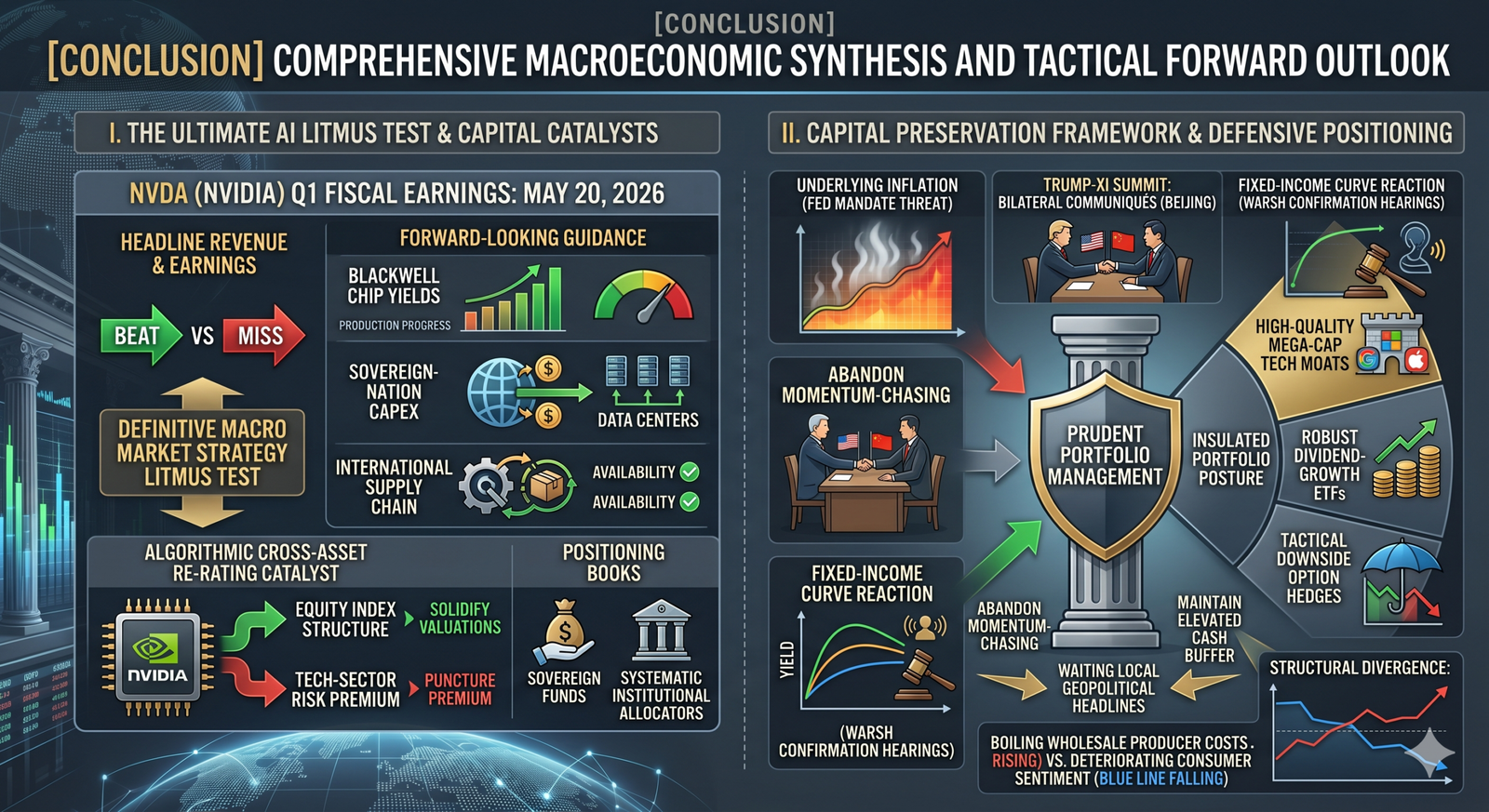
As global capital allocation networks navigate this treacherous landscape, the defining operational nexus for the upcoming trading week will undeniably center on Nvidia’s (NVDA) highly anticipated first-quarter fiscal earnings release scheduled for May 20, 2026. This singular data print has transcended microeconomic corporate analysis to become the definitive macro market strategy litmus test for the sustainability of the entire generative artificial intelligence investment thesis. Institutional desks are hyper-focused not merely on headline revenue beats, but on the forward-looking guidance metrics concerning next-generation Blackwell architecture chip yields, sovereign-nation capital expenditures, and international supply-chain component availability.
Given the top-heavy concentration of the current equity index structure, any operational or logistical guidance deviation from Nvidia will trigger an immediate, algorithmic cross-asset re-rating. Sovereign funds and systematic institutional allocators are positioning their books under the assumption that this report will either solidify the current premium valuations or act as the fundamental catalyst that punctures the overextended tech-sector equity risk premium, making it the most critical macro market event of the second quarter.
Capital Preservation Framework and Multi-Asset Defensive Positioning
In conclusion, because the underlying inflation data continues to hover at levels that actively threaten the Federal Reserve’s long-term price stability mandates, an aggressive, momentum-chasing approach to equity acquisition must be abandoned in favor of strict capital preservation. A sophisticated macro market strategy under these specific late-cycle conditions demands that asset allocators maintain an elevated cash or cash-equivalent buffer while awaiting the final, binding bilateral communiqués from the Trump-Xi summit in Beijing. Prudent portfolio management requires waiting out the weekend’s localized geopolitical headlines and monitoring the fixed-income curve’s reaction to the ongoing Kevin Warsh confirmation hearings before deploying new tranches of long-term risk capital.
Until the structural divergence between boiling wholesale producer costs and deteriorating consumer sentiment finds a definitive macro-level resolution, maintaining an insulated portfolio posture—underpinned by high-quality mega-cap technology moats, robust dividend-growth ETFs, and tactical downside option hedges—remains the only mathematically sound path to securing long-term alpha.
Further Reading
- LAC Stock Analysis: Massive Lithium Potential and Strategic Outlook
- Alphabet Stock Forecast 2030: Epic Bullish Analysis