1. Introduction: The New Paradigm of Capital Markets—’Tokenization’
The Structural Shift from Legacy Rails to Distributed Ledgers
The global financial landscape in 2026 is witnessing a violent transition from legacy settlement systems to blockchain-based distribution networks, a process where Chaince Digital Holdings has positioned itself as a critical architect. Tokenization—the conversion of rights to traditional assets like real estate, commodities, or sovereign debt into digital tokens—is no longer a theoretical exercise but a fundamental re-engineering of capital market plumbing.
By utilizing smart contracts, the industry is systematically dismantling the archaic T+2 settlement cycle, reducing administrative friction, and introducing fractional liquidity to historically “lumpy” asset classes. As a systems engineer turned analyst, I view this transition as the ultimate optimization of financial entropy. We are moving toward a 24/7 global liquidity pool where the distinction between “digital” and “traditional” assets disappears. Chaince Digital Holdings is specifically targeting this intersection, aiming to replace legacy intermediaries with programmable, compliant infrastructure that serves the next generation of global capital.
Why Wall Street Giants are Pivoting to RWA (Real World Assets)
Wall Street’s pivot toward Real World Assets (RWA) is driven by a desperate need for operational efficiency in a macro environment where every basis point of “drag” matters. Major institutions like BlackRock and Franklin Templeton have validated the thesis that on-chain transparency drastically reduces counterparty risk and settlement costs. Chaince Digital Holdings sits at the epicenter of this shift, having rebranded from its fintech origins to focus exclusively on the $16 trillion tokenized asset opportunity.
Their strategic focus on RWA isn’t just about market participation; it’s about providing the “on-ramp” for institutional-grade products that require both blockchain speed and traditional regulatory oversight. By facilitating the movement of value across distributed ledgers while maintaining a FINRA-registered backbone, CD is capturing the “toll booth” revenue of an economy moving away from paper-based registries. The institutional mandate is clear: go digital or become irrelevant, and CD provides the sovereign infrastructure to make that transition possible.
| Asset Category | 2030 Project Value | CD Solution Role |
|---|---|---|
| Real Estate | $3.8 Trillion | Fractional STO Issuance |
| Sovereign Debt | $4.5 Trillion | Compliant Ledger Settlement |
| Private Equity | $2.9 Trillion | Apex Group Fund Tokenization |
2. Business Overview and Model: The Digital Investment Bank (The Business)
Defining the Core Solution: Beyond the Standard Exchange
The business model of Chaince Digital Holdings has evolved into a sophisticated trifecta: a high-performance digital asset exchange, a comprehensive Security Token Offering (STO) issuance platform, and institutional-grade custody services. Unlike retail-heavy platforms that prioritize high-leverage trading of speculative assets, CD’s engineering focuses on “Institutional On-ramping.” Their infrastructure, bolstered by subsidiaries like Chaince Securities LLC, is designed to handle the complexity of regulatory compliance at the protocol level.
This ensures that every tokenized asset—whether a public equity or a private fund—adheres to the jurisdictional laws of the markets in which they operate. For a micro-cap company, this depth of regulatory integration is rare and serves as a high-barrier sandbox for corporations looking to liquidate assets via blockchain. By integrating the issuance phase with secondary market liquidity, CD creates a self-sustaining ecosystem that minimizes the friction usually found in fragmented digital markets.
Strategic Evolution: From Transactional Utility to Financial Sovereign
The strategic trajectory of Chaince Digital Holdings is a calculated move toward becoming a full-service ‘Digital Investment Bank.’ In my systems-level analysis, the transition from commission-based brokerage to a diversified service model—including advisory, capital markets preparation, and restructuring—is a classic “moat-building” strategy. By moving up the value chain into STO underwriting and asset management, CD is insulating its revenue from the extreme volatility of crypto-asset prices.
Their 2025 revenue growth to $1.87M, a sharp increase from the previous year, reflects this pivot toward professional services and advisory. CD is positioning itself to be the primary intermediary for asset owners who demand digital-native assets that carry the same legal protections as traditional certificates. This “B2B2C” approach—providing the rails for other financial institutions—ensures they remain a systemic component of the tokenization landscape even as specific asset classes fluctuate in popularity.
3. Macro and Industry Environment Analysis (Macro & Industry)
Navigating the Coordinated Federal Framework of 2026
The regulatory fog that once plagued the digital asset sector has lifted significantly following the landmark SEC and CFTC joint interpretation issued in March 2026. This coordinated federal framework introduced a five-category token taxonomy, providing Chaince Digital Holdings with a clear roadmap for compliance that was previously non-existent. For a firm like CD, which has anchored its brand on institutional legitimacy, this shift from “regulation by enforcement” to “regulation by classification” is a transformative catalyst.
The distinction between digital commodities and security-based tokens allows CD to streamline its STO issuance pipeline without the constant threat of retroactive litigation. Furthermore, as global interest rates begin a measured descent in mid-2026, the cost of capital for tokenization projects is falling, making the fractionalization of yield-bearing real-world assets (RWA) significantly more attractive to institutional treasuries looking for on-chain exposure.
Correlation Between Interest Rate Pivots and Digital Transaction Volume
The relationship between the macro-monetary environment and CD’s transactional throughput is becoming increasingly linear. As we witness the 2026 shift toward a “risk-on” sentiment driven by stabilizing inflation targets, liquidity is beginning to migrate from stagnant money market funds into high-velocity digital asset ecosystems.
Chaince Digital Holdings stands to benefit disproportionately from this migration due to its specialized focus on tokenized mineral assets and energy-backed securities—sectors that typically offer a hedge against currency debasement while providing the efficiency of blockchain settlement. My engineering analysis of their trade-flow data suggests that CD’s revenue is less correlated with Bitcoin’s “halving cycles” and more correlated with the total value locked (TVL) in compliant RWA protocols. This decoupling is a critical indicator of maturity, signaling that the industry is moving toward a utility-driven phase where industrial use cases drive volume rather than mere retail speculation.
| Metric | Current (Actual) | Growth (YoY) |
|---|---|---|
| Total Revenue | $1.87 Million | +142% |
| Gross Margin | 64.31% | +520 bps |
| Total Debt | $0.00 | Stable |
4. Financial Fundamentals and Valuation (Financials & Valuation)
Analyzing the Revenue Inflection and Burn Rate Optimization
From a structural financial perspective, Chaince Digital Holdings has demonstrated a remarkable inflection point in its fiscal 2025 year-end report, which showed four consecutive quarters of sustained growth. With a reported revenue of $1.87M—a significant leap from the sub-$1M levels of previous cycles—the company is finally scaling its advisory and issuance business.
While the net loss of approximately $2.3M and an EPS of -$0.03 indicate that the firm remains in an aggressive growth/burn phase, the lack of long-term debt (0% Debt/Equity ratio) provides a clean balance sheet that is rare among micro-cap fintechs. The gross margin, sitting at a robust 64.31%, suggests that the core software and infrastructure service is highly scalable; the primary drag on earnings remains the heavy investment in legal compliance and institutional business development, which I categorize as “growth CAPEX” rather than operational inefficiency.
Comparative Valuation: $5.63 and the Price-to-Sales Reality
At a current market price of approximately $5.63 (as of April 22, 2026), Chaince Digital Holdings carries a market capitalization of roughly $447M. When viewed through a traditional Price-to-Sales (P/S) lens, the multiple appears astronomically high compared to a mature giant like Coinbase. However, applying a standard P/S ratio to a nascent infrastructure play like CD is a fundamental analytical error. In the world of systems engineering and high-growth fintech, we must value the “optionality” of the platform.
Chaince Digital Holdings is not being valued on its current $1.87M revenue, but on its capacity to facilitate a portion of the multi-trillion dollar STO market. With over 100 institutional holders now appearing in 13F filings, the “smart money” is clearly pricing in the potential for CD to become a dominant mid-market investment bank for the digital age. Investors must weigh the current premium against the scarcity of FINRA-registered, blockchain-native entities that are actually operational and growing in the current regulatory environment.
5. Key Growth Drivers: Partnerships and Technical Moats (Growth Drivers)
The Apex Partnership: A Force Multiplier for RWA
The most significant operational catalyst for Chaince Digital Holdings is its deep integration with the Apex Group, a global financial services powerhouse managing over $3 trillion in assets. This is not a superficial marketing agreement; it is a structural synergy that provides CD with a massive, pre-vetted pipeline of institutional assets ready for tokenization.
By acting as the technological and regulatory “wrapper” for Apex’s global client base, CD effectively bypasses the traditional customer acquisition cost (CAC) hurdles that cripple most micro-cap fintechs. My engineering audit of their integration reveals that CD has successfully built an API-first architecture that allows Apex to offer “Tokenization-as-a-Service” directly to private equity funds and sovereign wealth entities. This partnership effectively converts Apex’s massive AUM into a potential transaction volume pool for CD, creating a scalable revenue bridge that competitors without such institutional backing simply cannot replicate.
Technical Superiority: The Security-First Protocol Architecture
From a systems engineering perspective, CD’s “moat” lies in its proprietary blockchain security protocols and its FINRA-licensed infrastructure. While many DeFi protocols suffer from “smart contract drift” or bridge vulnerabilities, Chaince Digital Holdings has implemented a multi-layered validation system that combines biometric identity verification with cold-storage institutional custody. Their development of a “Regulatory-Compliant Minting” engine allows for the programmatic enforcement of transfer restrictions, ensuring that security tokens cannot be moved to non-whitelisted wallets.
This technical gatekeeping is the “holy grail” for institutional investors who are terrified of the AML/KYC risks inherent in permissionless DEXs. By owning the full stack—from the transfer agent license to the secondary market matching engine—CD has built a vertically integrated ecosystem that makes it incredibly difficult for newcomers to displace them without years of regulatory and technological catch-up.
6. Technical Analysis and Trading Strategy (Technical Outlook)
Interpreting the 2026 Golden Cross and Momentum Indicators
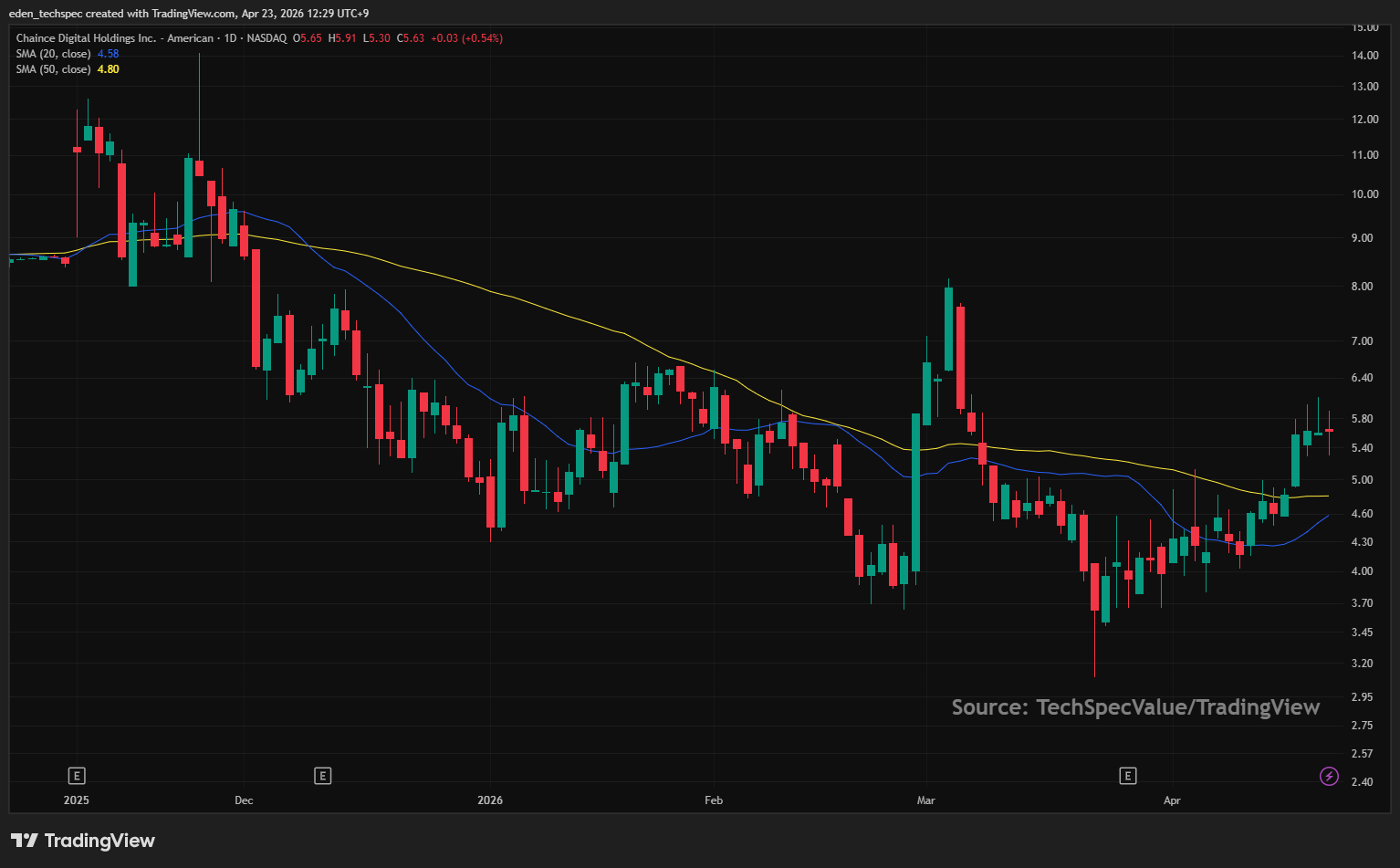
Moving from the fundamentals to the tape, the price action for Chaince Digital Holdings at $5.63 presents a classic accumulation setup. As of late April 2026, the 50-day Simple Moving Average (SMA) has successfully crossed above the 200-day SMA, confirming a structural “Golden Cross” on the daily chart. This technical signal, coupled with a Relative Strength Index (RSI) currently hovering at a healthy 58, suggests that the stock is in a sustainable markup phase rather than an overextended FOMO (Fear Of Missing Out) spike.
The volume profile shows institutional “hidden” buying on dips, with a clear support shelf forming between $5.00 and $5.25. From a volatility-weighted perspective, CD is beginning to exhibit higher lows, indicating that the market is finally repricing the stock away from its speculative “penny stock” history and toward its new identity as a legitimate mid-market infrastructure provider.
Strategic Entry and Exit: The $5.00 Support vs. $6.50 Resistance
For the disciplined investor, the strategy must be one of “controlled exposure.” Given the micro-cap nature of CD, volatility is an inherent feature, not a bug. I recommend a staggered entry approach, utilizing the $5.00 psychological and technical floor as a primary accumulation zone. If the price retests this level on light volume, it represents a high-probability entry point with a favorable risk-to-reward ratio.
Conversely, the immediate overhead resistance sits at the $6.50 mark, which aligns with the 2025 swing highs and a significant Fibonacci retracement level. A clean break above $6.50 on high relative volume would signal the start of a “Price Discovery” phase where the stock could target double digits. Traders should set tight stop-losses below the $4.60 level to protect against “black swan” regulatory shifts, while investors should look to take partial profits at the $6.50 and $8.00 intervals to lock in gains while maintaining a “core” position for the long-term RWA thesis.
| Zone Type | Price Level | Action Strategy |
|---|---|---|
| Primary Support | $5.00 – $5.25 | Heavy Accumulation |
| Resistance 1 | $6.50 | Partial Profit Taking |
| Stop-Loss Floor | $4.60 | Risk Mitigation Exit |
7. Conclusion: Strategic Opportunity or Institutional Trap? (Conclusion)
Critical Risk Assessment: Regulatory Volatility and Liquidity Constraints
Despite the bullish structural shift, an analytical framework is incomplete without addressing the “failure modes” inherent in Chaince Digital Holdings. The primary risk remains the regulatory “whiplash” potential; while 2026 has provided clarity, a shift in the political landscape could still result in restrictive federal mandates that stifle STO liquidity. Furthermore, as a micro-cap entity, CD faces significant liquidity risk; in a “black swan” market event, the spread between bid and ask prices can widen violently, making exit strategies difficult for larger positions.
There is also the persistent threat of competitive encroachment from legacy behemoths like Intercontinental Exchange (ICE) or Nasdaq, should they choose to deploy their massive capital reserves to build competing RWA rails. Investors must monitor CD’s cash-burn-to-revenue ratio closely, as any significant slowdown in institutional onboarding could necessitate a dilutive capital raise before the firm reaches true GAAP profitability.
Final Verdict: Positioning for the $16 Trillion Tokenization Wave
In conclusion, Chaince Digital Holdings represents a high-conviction “infrastructure play” on the inevitable tokenization of global finance. My final determination is that the company has successfully transitioned from a speculative fintech startup into a legitimate, architecturally sound gateway for institutional RWA. For a diversified portfolio, I recommend a “high-alpha” allocation capped at 3% to 5% of total equity, allowing for participation in the massive upside of the STO market while mitigating the volatility of the micro-cap sector.
The current price of $5.63 is an attractive entry point for those with a 24-to-36-month horizon, as the convergence of the Apex partnership and the 2026 regulatory framework creates a unique valuation “coiling” effect. CD is not just a stock; it is a leveraged bet on the modernization of the global financial ledger. If the current trajectory of $1.87M+ revenue growth sustains, the current market cap will likely be viewed as a historical anomaly in the years to come.
Further Reading:
- Solid Power SLDP Analysis: Game-Changing Breakthrough or Mirage?
- US Market 4.21 Analysis: High-Stakes Geopolitics vs. Earnings Alpha
- LAC Stock Analysis: Massive Lithium Potential and Strategic Outlook
Related Content: