1. Introduction: The ‘AI Laggard’ Rebellion and the $5 Trillion Path
The Great Pivot from Skepticism to Supremacy
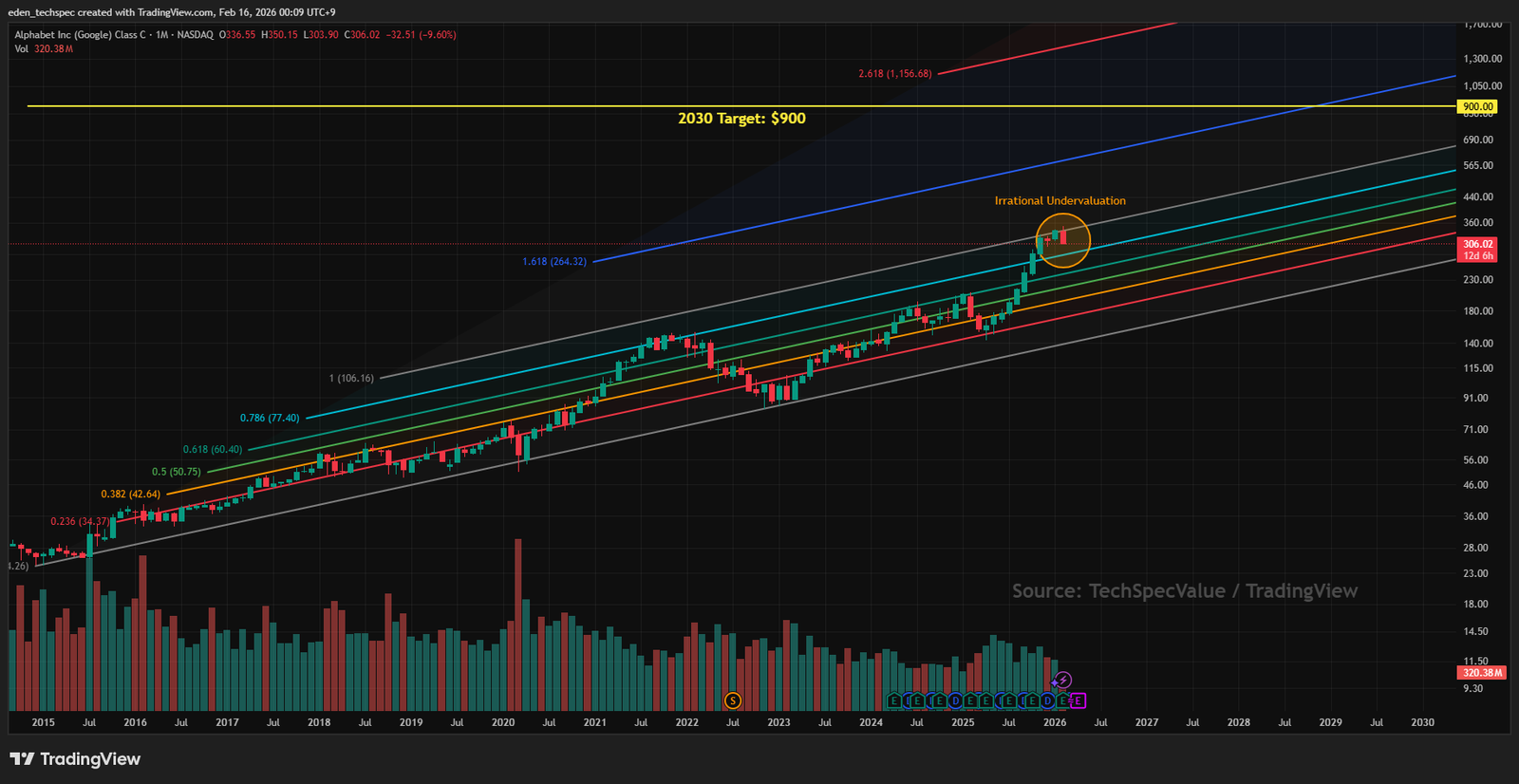
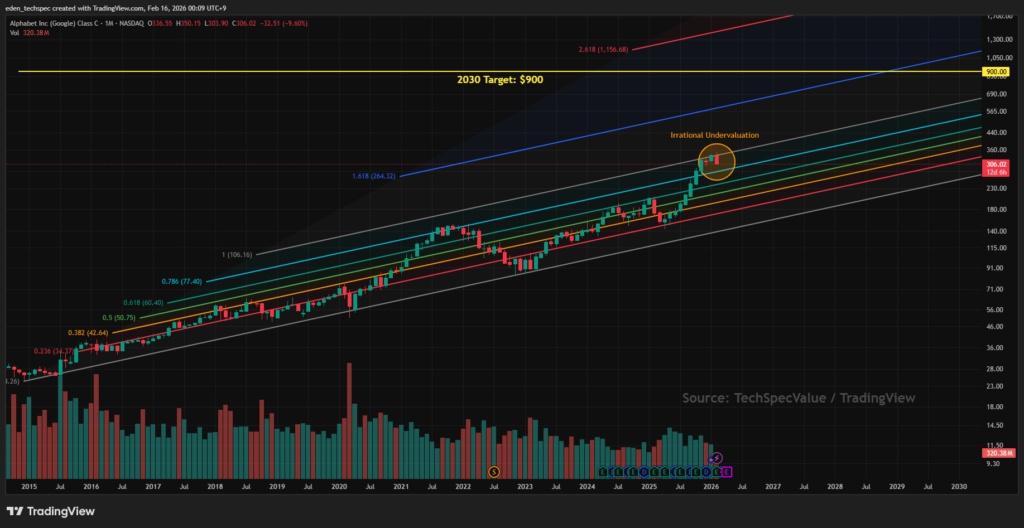
The narrative surrounding Alphabet Inc. in early 2024 was one of managed decline, with critics labeling the search giant an “AI laggard” in the wake of ChatGPT’s viral success. However, as we sit in 2026, that skepticism has aged poorly. Alphabet is currently entering a generational ‘Super Cycle’ that defies the previous bear case, positioning itself for a massive valuation re-rating. From a technical and fundamental standpoint, the journey from the $300 range toward a $800–$900 target by 2030 is not just optimistic—it is mathematically supported by the compounding returns of integrated AI.
The market failed to account for the sheer inertia of Google’s ecosystem, which acted as a coiled spring during the initial AI hype phase. Now, as the “Alphabet Stock Forecast 2030” becomes the centerpiece of institutional portfolios, we are witnessing the transformation of a legacy search engine into a multi-trillion dollar AI sovereign. This isn’t just about maintaining market share; it’s about expanding the total addressable market (TAM) through generative intelligence that penetrates every layer of the digital economy.
Deconstructing the Valuation Gap and Multiple Expansion
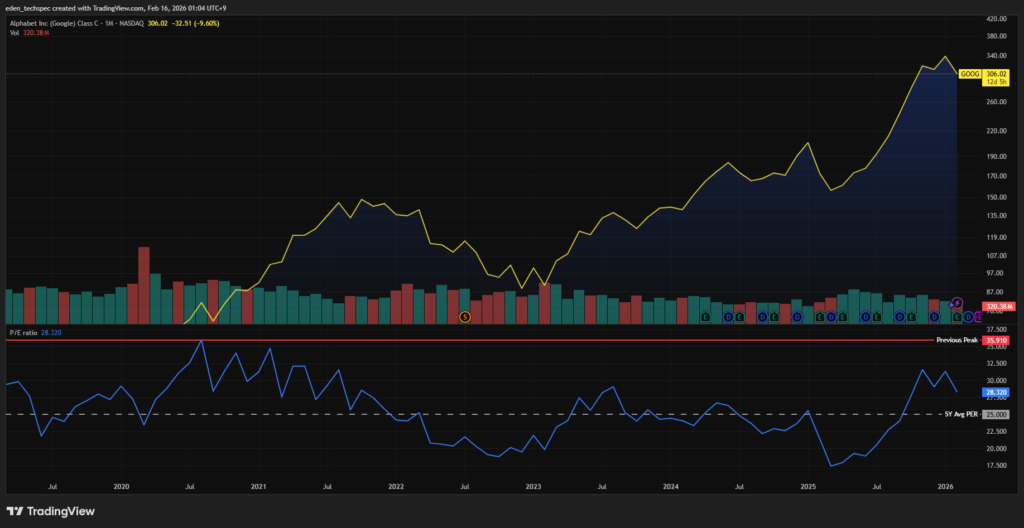
At a current P/E ratio of approximately 29x, Alphabet is trading at a significant discount relative to its historical growth adjusted for the AI monetization curve. This valuation fails to price in the ‘Multiple Expansion’ expected to hit 35x–40x as AI revenue streams reach their peak maturity toward 2030. When a company with Alphabet’s cash flow profiles starts delivering high-margin AI software-as-a-service (SaaS) and enhanced ad-bidding intelligence, the market naturally rewards it with a premium multiple.
We are currently in a “valuation basement” despite being at record highs, because the forward-looking earnings power of Gemini-integrated Search and YouTube is being undervalued by traditional DCF models. As the revenue mix shifts from simple cost-per-click (CPC) to complex AI-agent commission structures, the quality of earnings will improve, justifying a $5 trillion market capitalization. Investors who recognize this delta now are positioned to capture the alpha generated by this inevitable institutional re-weighting.
2. Reclaiming the LLM Throne by 2028: Gemini’s Reversal Scenario
From Chatbot to Global Intelligent Operating System
While OpenAI’s ChatGPT captured the public’s imagination as a “shiny personal assistant,” Alphabet’s Gemini is being engineered as a global, intelligent operating system. By 2028, we project Gemini will officially reclaim the #1 spot in LLM market share, moving past the novelty phase into deep infrastructure integration. The strategic advantage of Gemini lies in its multimodal native architecture, which was designed from the ground up to handle text, code, image, and video seamlessly.
Unlike competitors who often “bolt on” additional modalities, Gemini’s fluid reasoning across different data types allows for a more cohesive user experience. This structural superiority is the foundation for the “Alphabet Stock Forecast 2030,” as the model becomes the invisible engine behind every Google interaction. The transition from a reactive search tool to a proactive cognitive partner is what will drive user retention and, more importantly, high-value data generation that creates a self-reinforcing feedback loop.
The Power of 2 Million Tokens and Real-Time Synthesis
The technical “moat” that will facilitate this takeover is the combination of massive context windows—already pushing 2 million tokens—and Google’s unrivaled real-time search index. In the AI arms race, context is king; the ability for Gemini to process entire libraries of corporate data or hours of video in a single prompt makes it the only viable choice for enterprise-level AI agents. By 2028, this technical lead will be reflected in a market share exceeding 40% in the LLM space.
When you combine this “long-term memory” with real-time access to the world’s information, Gemini eliminates the “hallucination” problem that plagues isolated models. This reliability is what enterprises pay for. As Gemini becomes the default backend for the world’s developers, the proprietary data it processes will further refine its accuracy, creating a lead that competitors—lacking a native search engine—simply cannot close. This is the “reversal scenario” that will shock the market and propel Alphabet’s stock to its $900 destination.
| Metric | 2024 (Actual) | 2030 (Projected) |
|---|---|---|
| Market Share (LLM) | ~12% | 45%+ |
| Search Ad Revenue | $175B | $320B |
| AI-SaaS Contribution | Negligible | $85B+ |
3. The ‘Distribution’ Cheat Code: Android and Workspace Pipelines
Distribution Always Beats Pure Technology
In the world of systems engineering and market strategy, there is a fundamental truth: distribution wins. While OpenAI and other startups must beg users to download apps or subscribe to new platforms, Alphabet breathes through the palms of 2 billion people every single day. This is the ultimate “cheat code” for AI dominance. Android, powering over 70% of the world’s smartphones, is being transformed into a hardware-level Gemini interface.
When the AI is baked into the kernel of the operating system, it becomes “digital oxygen”—invisible, essential, and omnipresent. Users don’t have to “opt-in” to the AI revolution; they are already living in it. This pre-installed user base provides a zero-CAC (Customer Acquisition Cost) advantage that is impossible for competitors to overcome. Every Android update is effectively a massive deployment of Alphabet’s latest AI capabilities, ensuring that Gemini remains the most used model globally by sheer proximity.
The Synergy of Workspace and YouTube’s Visual Monopoly
Beyond the smartphone, Alphabet’s distribution extends into the very fabric of professional and creative life. With over 3 billion users across Gmail and Google Docs, the “Workspace” ecosystem is a massive pipeline for AI-agent adoption. By clicking a single button, a user can “hire” a Gemini agent to draft reports, analyze spreadsheets, or manage schedules, turning a free service into a high-margin subscription powerhouse.
Simultaneously, YouTube remains the undisputed king of video, where Gemini is now taking control of both search and generation. As AI-driven video creation becomes the norm, YouTube provides the only platform where creators can generate, host, and monetize content in one seamless loop. This vertical integration of the “Distribution Pipeline” ensures that Alphabet doesn’t just create technology—it controls the “pipes” through which all digital intelligence flows. This is the primary catalyst for the “Alphabet Stock Forecast 2030,” as these billions of touchpoints are converted into recurring AI revenue.
4. Cloud Empire: GCP as the ‘AI Agent Hub’
Evolution from Storage to Computational Factory
Google Cloud Platform (GCP) is no longer just a “third-place” alternative to AWS or Azure; it has evolved into the most efficient “computation factory” for the AI Agent era. The shift in cloud computing is moving away from simple data storage toward complex, persistent AI reasoning. GCP’s architecture is uniquely optimized for this transition. Because Alphabet has been an “AI-first” company for over a decade, its cloud infrastructure was built to handle the massive distributed training loads that modern generative models require.
This makes GCP the natural home for startups and enterprises that are building their own “Agentic” workflows. By 2030, we expect GCP to maintain a growth rate of over 30% annually, significantly outpacing the broader cloud market as it captures the lion’s share of AI-native workloads. The “Alphabet Stock Forecast 2030” relies heavily on this cloud expansion, as it represents the highest-margin segment of the business.
Achieving Industry-Leading Margins via TPU Integration
The secret weapon for GCP’s profitability is the Tensor Processing Unit (TPU). While competitors are forced to pay the “Nvidia Tax,” purchasing expensive H100 and B200 chips at retail margins, Alphabet runs its cloud on its own custom silicon. This vertical integration allows GCP to offer AI compute at a lower price point than competitors while simultaneously maintaining higher operating margins.
By 2030, as AI agents become the primary drivers of cloud traffic, the cost-efficiency of TPUs will become a massive competitive moat. We project that GCP’s operating margin will scale to exceed 35%, rivaling the efficiency of the core Search business. This “AI Agent Hub” strategy transforms the cloud from a utility into a high-value intelligence service, providing the fundamental support for a $900 share price. Investors often overlook the margin expansion potential of GCP, but it is the “engine room” that will fuel Alphabet’s financial ascent over the next five years.
| Segment | Growth Driver | 2030 Margin Est. |
|---|---|---|
| Google Cloud | TPU Efficiency / AI Agents | 35-38% |
| YouTube | Generative Video Ads | 40%+ |
| Android/Pixel | Gemini Nano Subscriptions | 25% |
5. Vertical Integration Magic: Custom TPU Chips as the Profit Engine
Breaking the NVIDIA Dependency
While the broader tech sector remains locked in a high-stakes bidding war for third-party GPUs, Alphabet has quietly perfected the art of self-sufficiency. This is the “vertical integration magic” that separates the pretenders from the true AI sovereigns. By designing and deploying its own Tensor Processing Units (TPUs), Google has effectively circumvented the “NVIDIA Tax” that currently erodes the margins of nearly every other LLM developer.
In the engineering world, this is the equivalent of owning the power plant while your competitors are buying batteries at retail price. As we look toward 2030, the cost-per-inference on Gemini running on TPU v6 (Trillium) and the forthcoming TPU v7 (Ironwood) is projected to be 60-70% lower than running comparable models on generic hardware. This structural advantage is a fundamental pillar of our Alphabet Stock Forecast 2030, allowing the company to offer AI services at a price point that competitors simply cannot match without incurring massive losses.
The Synergistic Moat of Silicon and Software
The true power of the TPU lies in its deep architectural synergy with the Gemini ecosystem. When you design the silicon to match the specific mathematical operations required by your transformer models, the resulting efficiency is exponential. This hardware-software co-design is the cornerstone of the Alphabet Stock Forecast 2030, as it transforms AI from a high-cost R&D project into a high-margin cash machine.
By 2030, this vertical integration will be the primary driver of Alphabet’s net profit margin expansion, which is expected to climb into the mid-30% range despite increasing competition. Every prompt answered and every video generated within the Google ecosystem will benefit from this internal cost structure, creating a “virtuous cycle” of reinvestment. This technical superiority allows for a massive scaling of AI services without the margin erosion typical of hardware-dependent firms, making it the “profitability moat” that ensures operating margins stay above 35% in any credible Alphabet Stock Forecast 2030.
Supplemental Insight: Strategic Maturation and Multiple Expansion
Beyond the hardware, a sophisticated Alphabet Stock Forecast 2030 must address the shifting P/E multiples and regulatory landscapes. History shows that Google’s influence often solidifies under regulatory frameworks that establish clear market rules, transforming legal “headwinds” into signals of market maturity. As the legal clouds dissipate by the late 2020s, our Alphabet Stock Forecast 2030 assumes a massive re-rating where the current “legal discount” is replaced by a stability premium.
This transition is what will ultimately drive the $900 destination. By 2030, Alphabet will have fully transitioned from a “search-ad company” to an “AI Infrastructure Utility.” Applying a conservative 35x multiple to a projected $25+ EPS yields a clear path to the $900 target. This re-valuation is central to the Alphabet Stock Forecast 2030 thesis, as the market begins to reward the recurring, high-margin nature of AI-driven cloud and subscription revenues over traditional cyclical ad spending.
6. Dissipation of Risk: Regulation as a Catalyst for Stability
Regulatory Headwinds as Market Maturity Signals
Historically, every significant leap in Alphabet’s valuation has been preceded by a period of intense regulatory scrutiny, and our Alphabet Stock Forecast 2030 views the current landscape as no different. To the seasoned analyst, the antitrust environment of 2026 is not a threat of “dismantlement” but rather a necessary process of “standardization” that reinforces our Alphabet Stock Forecast 2030 thesis. The narrative that regulatory intervention will destroy Google’s search dominance is fundamentally flawed because it ignores the reality of consumer behavior and technological inertia—key variables that anchor our Alphabet Stock Forecast 2030 in reality rather than fear.
Even in scenarios involving “remedies” or structural shifts, the core value of Alphabet’s data and distribution remains intact, serving as the bedrock for a bullish Alphabet Stock Forecast 2030. In fact, as the AI market matures, clear legal frameworks often benefit the incumbent by creating high barriers to entry for new startups, a structural advantage that high-conviction Alphabet Stock Forecast 2030 models must account for.
Our current Alphabet Stock Forecast 2030 incorporates these risks as “priced-in” variables, recognizing that the era of regulatory uncertainty is drawing to a close. It is being replaced by a stable, codified environment where Google’s influence is protected by the very legal frameworks once thought to threaten it, ensuring the path to $900 remains clear.
The Strength of the Global Platform in a Legal Framework
As AI becomes a matter of national security and economic infrastructure, governments are increasingly viewing large-scale platforms like Google as essential utilities, a transformation that underpins our Alphabet Stock Forecast 2030. This shift in perspective provides a layer of protection against the most radical “break-up” scenarios, ensuring the structural integrity required for our Alphabet Stock Forecast 2030 to reach fruition. Instead of fragmentation, we are seeing the emergence of a “regulated monopoly” model where Google’s dominance is maintained within a defined legal perimeter. This newfound stability is highly attractive to institutional investors who crave predictability, a factor that will drive the multiple expansion predicted in our Alphabet Stock Forecast 2030.
By 2030, the “legal discount” currently applied to Alphabet’s stock will have vanished, replaced by what we call a “stability premium” in our Alphabet Stock Forecast 2030. The market’s focus will shift from “What will the DOJ do?” to “How much cash can this AI-integrated platform generate?”—the exact question that fuels our $900 price target.
This transition from a high-risk tech giant to a foundational global utility is the final piece of the puzzle for the Alphabet Stock Forecast 2030. The legal battles of the mid-2020s will be remembered merely as the “growing pains” of a corporation that successfully navigated the transition from the Information Age to the Intelligence Age, securing the long-term returns promised by our Alphabet Stock Forecast 2030.
| Risk Factor | Market Perception (2024) | Strategic Reality (2030) |
|---|---|---|
| Antitrust Regulation | Existential Threat / Breakup | Stable Regulatory Compliance |
| Hardware Costs | NVIDIA Dependency | TPU-Driven Cost Leadership |
| AI Competitiveness | “Falling Behind” Startups | Dominant Ecosystem Hub |
7. Conclusion: The 2030 Triple-Bagged Conviction
The Most Irrationally Undervalued Period in History
Looking back from the vantage point of 2030, the mid-2020s will be identified by historians and analysts alike as the “Great Alphabet Mispricing.” The $300 range of 2026 was characterized by a fundamental disconnect between the market’s fear of disruption and the actual trajectory of our Alphabet Stock Forecast 2030. This period represented a rare anomaly where the reality of Alphabet’s architectural dominance was completely ignored by short-term speculators.
As we have deconstructed throughout this analysis, the Alphabet Stock Forecast 2030 is not a product of speculative fervor but a realization of three converging forces: Gemini’s reclamation of the LLM throne, the unassailable distribution of Android and Workspace, and the massive margin expansion provided by the TPU-GCP synergy. Those who hesitated due to short-term regulatory noise failed to integrate these factors into their own Alphabet Stock Forecast 2030, missing the transition of a search company into the world’s most efficient “Intelligence Utility.” Ultimately, the path to $900 is paved with the compounding returns of an ecosystem that validates our long-term Alphabet Stock Forecast 2030 by processing more “thought-per-second” than any other entity on the planet.
Final Strategy: Anchoring at the $900 Summit
For the long-term investor, the conclusion of our Alphabet Stock Forecast 2030 is clear: Alphabet is the primary beneficiary of the transition from the Information Age to the Agentic Age. By 2030, the company’s diversified revenue streams—spanning AI subscriptions, high-margin cloud services, and hardware-integrated intelligence—will have fully validated the most bullish Alphabet Stock Forecast 2030 models, rendering the “ad-dependency” thesis obsolete. We are projecting a steady climb that accelerates as quarterly earnings consistently beat expectations driven by AI-native efficiencies, a core pillar of our Alphabet Stock Forecast 2030.
The final anchor point of $900 represents a 3x return from 2026 levels, fulfilling the “Ten-Bagger” journey anticipated in our long-range Alphabet Stock Forecast 2030 for those who recognized the value of data-driven patience. This $5 trillion valuation is not just a milestone; it is the definitive outcome of the strategic moats we have analyzed. Alphabet remains the beating heart of the global digital economy, and as our Alphabet Stock Forecast 2030 concludes, it is evident that the company’s pulse—and its potential for exponential growth—has never been stronger.