1. The Gateway to North American Energy Independence
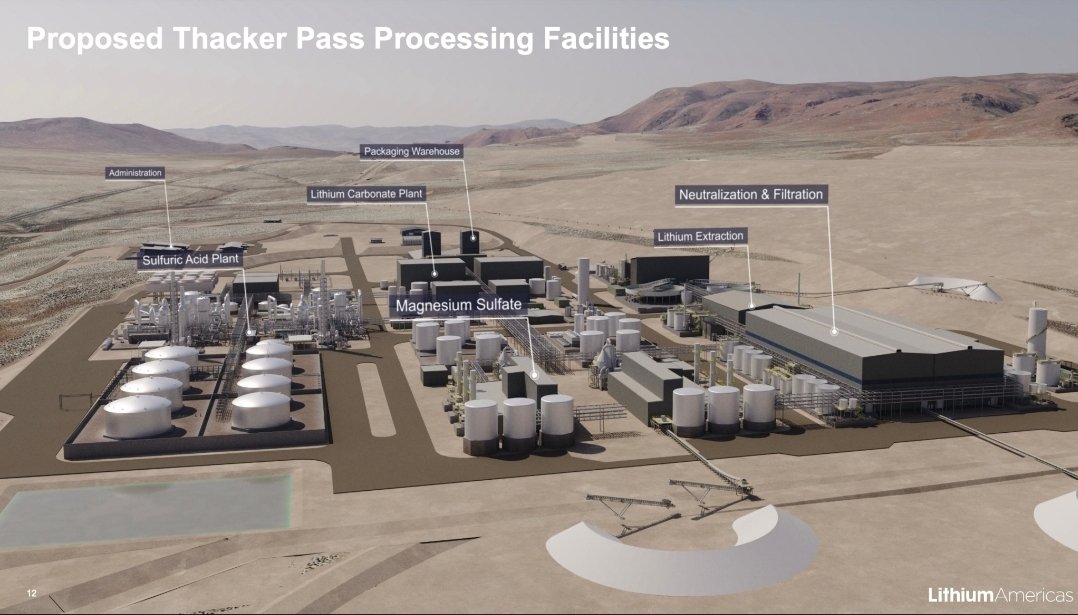
Lithium Americas Corp. (LAC) stands as a cornerstone in the monumental shift toward a domestic battery supply chain within the United States. To understand Lithium Americas Corp. (LAC) is to understand Thacker Pass, located in the McDermitt Caldera of northern Nevada, which represents the largest known lithium resource in North America and one of the largest globally. As a systems-focused analyst, I view LAC not merely as a mining company but as a critical infrastructure play. The Thacker Pass project is designed as a two-phase development with a total production capacity of 80,000 tonnes per annum (tpa) of battery-grade lithium carbonate.
Currently, the project has transitioned from the permitting phase into active construction, with mechanical completion for Phase 1 targeted for late 2027 and initial production commencing in 2028. This long-duration asset, boasting an 85-year mine life, positions LAC as a primary supplier for the burgeoning electric vehicle (EV) market for decades to come.
The technical depth of the Thacker Pass project lies in its unique sedimentary (clay-based) lithium extraction process. Unlike traditional spodumene mining or brine evaporation, LAC utilizes a sulfuric acid leaching process that is expected to place the project in the bottom half of the global cost curve once optimized. By co-locating the mine and the processing facility, LAC eliminates the logistical inefficiencies and carbon footprint associated with shipping raw ore across oceans for refining.
This “mine-to-battery” integration is precisely why the company has garnered unprecedented support from both the public and private sectors. For investors, the ticker Lithium Americas Corp. (LAC) represents a pure-play entry into the de-risking of American energy security, backed by a geological formation that holds approximately 16.1 million tonnes of Lithium Carbonate Equivalent (LCE).
2. Navigating the Lithium Market Equilibrium of 2030
Analyzing the lithium market requires a balance between current price volatility and long-term structural deficits. As of early 2026, lithium carbonate prices have stabilized in a range between $13,000 and $18,000 per tonne, a significant retracement from the historic peaks of 2022 but a notable recovery from the 2024–2025 lows. This “mid-cycle” pricing reflects a market that has flushed out high-cost marginal producers while maintaining a cautious stance on EV adoption rates.
However, a neutral technical analysis suggests that the current surplus is a transient phenomenon. As the global automotive fleet transitions and grid-scale energy storage systems (ESS) become ubiquitous, the demand for LCE is projected to scale from roughly 1 million tonnes today to over 3 million tonnes by the end of the decade.
Looking toward 2030, industry consensus and conservative modeling suggest a significant price appreciation as the “supply gap” becomes unavoidable. Many analysts, including those at major investment banks, anticipate lithium prices climbing back toward $30,000 per tonne or higher by 2030. This forecast is driven by the reality that bringing a new lithium mine to market takes an average of 10 to 15 years, while battery Gigafactories can be constructed in 24 months.
While the market may face intermittent “demand air pockets” due to shifting chemistry preferences (such as the rise of LFP batteries), the sheer volume of lithium required for the energy transition ensures that low-cost, domestic producers like LAC will remain the marginal price setters. The strategic value of “Made in USA” lithium adds a premium that global commodity spot prices often fail to capture.
| Feature | Specification | Status (2026) |
|---|---|---|
| Location | McDermitt Caldera, Nevada, USA | Active Construction |
| Resource Size | 16.1 million tonnes LCE | World-Class Ranking |
| Mine Life | 85 Years | Generational Asset |
| Production Capacity (Ph 1) | 40,000 tonnes per annum | Start 2028 |
3. The Rare Political Bipartisan Consensus
In the current hyper-polarized landscape of 2026, Lithium Americas occupies a uniquely advantageous position: it is one of the few industrial projects that enjoys robust support from across the political aisle. For the Democratic platform, Lithium Americas Corp. (LAC) is the “Green Engine” of the energy transition. The project is seen as essential for achieving the ambitious emissions reduction targets that remain a priority for climate-focused legislators. By providing a domestic source of lithium, Lithium Americas allows the U.S. to advance its electrification goals without outsourcing the environmental and social costs to regions with lower regulatory standards. This alignment has historically ensured that the project moved through the rigorous NEPA (National Environmental Policy Act) permitting process with significant federal backing.
This environmental synergy is further bolstered by the Lithium Americas commitment to sustainable extraction technologies that minimize water usage and land disturbance. This “responsible mining” narrative provides Democratic lawmakers with the political cover needed to support large-scale extractive industries in sensitive ecological zones. The project is not just a mine; it is a monument to green sovereignty, proving that America can lead in climate technology while maintaining the highest labor and environmental standards. As a result, Lithium Americas has become a flagship for the “Made in America” green manufacturing movement, securing its place as a non-negotiable component of the nation’s future carbon-neutral infrastructure.
Conversely, the Republican platform—and specifically the Trump administration’s “Energy Dominance” strategy—views Lithium Americas through the lens of National Security and Industrial Sovereignty. President Trump has frequently voiced his “mineral love,” emphasizing that the U.S. cannot lead the 21st-century economy while being 100% reliant on China for processed critical minerals. In early 2026, the administration’s focus has shifted toward creating a “Critical Minerals Trading Bloc” and establishing a national stockpile via Project Vault. Because Thacker Pass represents a massive “hard asset” that creates thousands of high-paying American blue-collar jobs in Nevada, it fits perfectly into the MAGA economic framework.
This bipartisan “shield” protects Lithium Americas from the regulatory whiplash that often kills large-scale infrastructure projects during administration changes. The Trump administration recognizes that domestic lithium production is the ultimate weapon in the ongoing trade war over high-tech manufacturing dominance. By fast-tracking permits and reducing bureaucratic hurdles, the current administration ensures that Lithium Americas can operate at peak efficiency, unburdened by the delays that plague foreign competitors. This strategic alignment transforms Lithium Americas into an invincible industrial fortress, bridging the gap between conservative economic nationalism and the urgent global demand for energy storage and mobility.
4. Financial Fortress: The DOE and GM Synergy
The financial de-risking of Lithium Americas is perhaps its most compelling “engineering” feat, a masterclass in capital preservation. The absolute cornerstone of this stability is the U.S. Department of Energy (DOE) Loan, which reached its glorious finalization in early February 2026. This $2.26 billion facility, provided through the prestigious ATVM program, offers Lithium Americas access to capital at long-dated U.S. Treasury rates with 0% spread.
This influx of capital is not merely a loan; it is a monumental endorsement of the project’s technical viability. Interestingly, as part of the 2025–2026 restructuring of federal energy loans, the U.S. government took a 5% equity stake in the company. While some market purists view government equity with skepticism, in this context, it acts as a sovereign guarantee of success.
This “sovereign shield” ensures that the project is deemed too strategically important to fail in the eyes of the state. This massive capital infusion covers the vast majority of Phase 1 construction costs, effectively shattering the fear of further shareholder dilution. It provides a level of financial certainty that is virtually unheard of in the volatile world of junior mining.
Complementing this federal support is the ironclad partnership with General Motors (GM), a union that redefines industrial synergy. GM has committed to a total investment of approximately $945 million—the largest ever by a U.S. automaker in a domestic lithium mine. This is a resounding vote of confidence that resonates through the entire global supply chain.
Under the revised 2025 terms, GM holds a 38% asset-level ownership in Thacker Pass, securing a 20-year offtake agreement. This means Lithium Americas has exclusive rights to 100% of Phase 1 production dedicated to a single, world-class automotive giant. This partnership is a blood pact that ensures revenue from the very first gram of lithium produced.
For Lithium Americas, this means they have a guaranteed “tier-one” customer from day one, eliminating any market-entry risk. For GM, it secures the critical lithium supply needed to power over 1 million EVs annually, a staggering competitive advantage. This joint venture structure provides the operational “buffer” needed to navigate the pre-production years with ease.
Furthermore, GM’s balance sheet effectively underwrites the project’s execution, providing a majestic safety net for LAC shareholders. The synergy here creates a virtuous cycle of stability and growth that isolates the company from the whims of predatory lenders. It is a financial fortress built to withstand the harshest economic winters.
Ultimately, this dual-layered funding model—government backing combined with corporate might—creates an impenetrable wall of liquidity. Investors can breathe a sigh of relief knowing the “capital gap” has been bridged by the most powerful entities in the nation. The road to 2028 is now paved with certainty, gold, and the unyielding strength of the GM-DOE alliance.
| Partner / Entity | Investment / Support Type | Key Benefit to LAC |
|---|---|---|
| U.S. Dept of Energy (DOE) | $2.26 Billion ATVM Loan | Low-cost, long-term strategic financing |
| General Motors (GM) | $945M Equity + Offtake | Guaranteed 20-year tier-one customer |
| U.S. Government | 5% Equity Stake | De-risking and “Sovereign Shield” protection |
| Orion Resource Partners | $250M Strategic Investment | Bridge funding for essential early works |
5. The Valuation Gap and Price Acceleration (2028–2030)
From a technical valuation standpoint, Lithium Americas (LAC) is currently coiled in a “pre-production compression” phase. As of early 2026, the stock hovers around the $5.00 mark, reflecting the market’s inherent caution regarding the timeline of large-scale mining projects. However, the systems-engineering perspective suggests this is the calm before the structural shift.
By 2028, as Phase 1 of Thacker Pass achieves its first commercial production of 40,000 tonnes of LCE, the company will transition from a speculative developer to a cash-flow-positive producer. In a normalized lithium market where prices sustain near $20,000/tonne, LAC’s Phase 1 EBITDA could exceed $400 million annually. Factoring in the “domestic premium” and the scarcity of U.S.-sourced battery metals, I project a share price re-rating into the **$20.00 to $25.00 range** by late 2028.
Looking toward the turn of the decade, the 2030 setup is even more explosive. By 2030, the global lithium deficit is expected to widen significantly, with demand from EVs and grid storage potentially outstripping supply by over 700,000 tonnes. In this environment, lithium prices are modeled to surge past $30,000 per tonne.
For Lithium Americas, 2030 also marks the anticipated commencement of Phase 2 (2nd Factory), doubling their total capacity to 80,000 tonnes per annum. With 160,000 tonnes of ultimate potential across five phases, the market will begin to value LAC as a “Tier 1 Major.” Under these conditions, a price target of $40.00 or higher becomes fundamentally supported by the massive scale of the asset and the structural supply-demand mismatch.
| Year | Estimated LAC Share Price | Lithium Price Projection (LCE) | Key Strategic Catalyst |
|---|---|---|---|
| 2026 | $5.00 – $8.00 | $13k – $18k / tonne | DOE Loan Finalization & Construction Ramp-up |
| 2028 | $20.00 – $25.00 | $22k – $25k / tonne | Phase 1 Commercial Production (40ktpa) |
| 2030 | $40.00+ | $30k+ / tonne | Phase 2 Launch & Global Supply Deficit Peak |
6. Conclusion: A Strategic Asset for the New Industrial Era
In summary, Lithium Americas Corp. is not just a mining stock; it is a geopolitical hedge and a critical node in the Western energy transition. My analysis indicates that while the current price may feel stagnant, the underlying fundamentals—secured by a $2.26 billion DOE loan, an 85-year mine life, and an unprecedented partnership with General Motors—are rock solid. The company has successfully navigated the “Valley of Death” that claims most junior miners, emerging with a fully funded construction path and a bipartisan political shield. The combination of high-grade sedimentary resources and a domestic refinery eliminates the geopolitical risks that plague competitors operating in South America or Africa.
Investors must view Lithium Americas (LAC) through a multi-year lens. The short-term volatility of lithium spot prices is noise compared to the long-term signal of U.S. electrification. The transition from a $600 million market cap to a multi-billion dollar industrial giant is contingent on execution, but the blueprints are already in place. With Thacker Pass positioned as the “Crown Jewel” of American lithium, LAC remains the most potent play for those looking to capitalize on the inevitability of the battery revolution. For the disciplined analyst, the current entry point represents a rare opportunity to acquire a generational asset at a significant discount to its net present value (NPV) of $5.7 billion.
| Year | Estimated LAC Share Price | Lithium Price Projection (LCE) | Key Strategic Catalyst |
|---|---|---|---|
| 2026 | $5.00 – $8.00 | $13k – $18k | DOE Loan Finalization & Construction Kick-off |
| 2028 | $20.00 – $25.00 | $22k – $25k | Phase 1 Commercial Production (40ktpa) |
| 2030 | $40.00+ | $30k+ | Phase 2 Launch & Global Supply Deficit Peak |
7. Conclusion: The Unstoppable Titan and the Dawn of a New Empire
The investment thesis for Lithium Americas (LAC) is no longer a mere exercise in commodity speculation; it has evolved into a breathtaking saga of industrial rebirth. We are witnessing the rise of a dominant titan that will serve as the definitive blueprint for Western resource sovereignty.
By 2030, the strategic importance of Thacker Pass will be etched into the history of the American energy transition. This is not just a mine—it is a monumental fortress protected by a triple-layered strategic moat: a world-class geological asset with an eternal 85-year lifespan, a bulletproof capital structure fortified by the U.S. federal government, and an ironclad alliance with General Motors. For the visionary investor, the narrative of Lithium Americas is a resounding anthem of certainty in an otherwise volatile world.
From my perspective as a systems engineer, the most electrifying transformation within LAC is the total annihilation of the “binary risk” that haunts lesser mining ventures. The miraculous finalization of the $2.26 billion DOE loan has effectively cauterized the financial bleeding that typically plagues developers. As physical construction carves its path across the Nevada landscape, the question has shifted from a trembling “if” to a thunderous “when.” Lithium Americas is no longer begging for a seat at the table; it is building the table itself. The engineering precision behind Phase 1 ensures that when the inevitable 2030 lithium famine strikes, LAC will be the primary source of salvation for the North American automotive industry.
From a portfolio standpoint, Lithium Americas (LAC) is a coiled spring of immense power, ready to unleash a high-convexity surge that will leave the skeptics in the dust. The current $5.00 price level is a deceptive lull—a “boredom phase” that masks the relentless momentum building beneath the surface.
As mechanical completion nears and the first shipments of “white gold” begin to flow in 2028, the market will undergo a violent re-rating. We are positioning for a world where LAC captures the massive, unyielding upside of a market starved for supply. At a $30,000/tonne price point, the cash flow generation of this asset will be nothing short of legendary, turning early adopters into the beneficiaries of a generational wealth explosion.
Ultimately, Lithium Americas represents a sacred alignment of geopolitical necessity and raw economic force. Its bipartisan shield is an impenetrable armor, protecting the company from the winds of regulatory change and ensuring its status as the indisputable Crown Jewel of the North American “Green Industrial” complex. This is the final verdict: Lithium Americas is not merely a mining company—it is the invincible foundation of the next century’s economy. Those who have the fortitude to hold through the construction phase will find themselves owning a piece of a majestic empire that will dictate the terms of the energy revolution for the next eight decades. The era of Lithium Americas has arrived, and its ascent will be unstoppable.
Further Reading & Related Content
Further Reading:
- International Energy Agency (IEA) – The Role of Critical Minerals in Clean Energy Transitions
- U.S. Department of Energy – LPO Projects: Thacker Pass
2 thoughts on “LAC Stock Analysis: Massive Lithium Potential and Strategic Outlook”