1. Macroeconomics and Tesla’s Strategic Positioning in 2026
The Intersection of Interest Rates and AI Infrastructure
As we navigate the second quarter of 2026, the macroeconomic landscape presents a complex duality that demands a sophisticated engineering-grade analysis of Tesla’s position. For the past two years, the global economy has been defined by a “higher-for-longer” interest rate environment, which naturally exerted downward pressure on high-ticket consumer discretionary items like electric vehicles (EVs). However, we are currently witnessing a pivotal shift where the scarcity of AI-ready power infrastructure is becoming the primary bottleneck for global growth. In this context, Tesla is no longer merely an automotive manufacturer subject to the whims of cyclical credit markets; it has evolved into a foundational layer of the physical AI economy.
The “growth pains” observed throughout 2024 and 2025—characterized by margin compression and cooling demand—have effectively acted as a pressure test for the company’s balance sheet. As the Federal Reserve signals a more accommodative stance to support the energy-intensive AI revolution, Tesla stands uniquely positioned to capture value at the intersection of decentralized energy storage and autonomous compute. The market is currently undergoing a violent repricing of Tesla’s multiples, shifting from a hardware-based P/E ratio to an AI-SaaS valuation model, a transition that is often misunderstood by traditional automotive analysts but crystal clear to those tracking the convergence of energy density and neural network scaling.
Decoupling from the Traditional EV Cycle
The narrative surrounding the “EV slowdown” has been the dominant bearish catalyst for Tesla over the last 24 months, yet a deeper systems analysis reveals a decoupling of Tesla’s intrinsic value from the broader automotive sector. While legacy OEMs struggle with the capital-intensive transition to software-defined vehicles, Tesla has utilized the 2024-2025 downturn to aggressively verticalize its supply chain and optimize its “machine that builds the machine.” By early 2026, the company has successfully integrated advanced structural battery packs and front/rear mega-castings across its entire lineup, drastically reducing the bill of materials (BOM).
This structural cost advantage allows Tesla to maintain a “value stock” floor in terms of cash flow while retaining the “AI growth stock” ceiling. We are seeing a structural shift where institutional capital is moving away from pure-play EV competitors who lack an ecosystem and toward Tesla as a diversified play on the future of labor (Optimus) and energy (Megapack). The current market sentiment reflects a period of “productive friction,” where the volatility in share price masks the underlying build-up of technical debt-free assets. From a systems engineering perspective, Tesla has effectively completed its transition from a high-beta growth experiment to a mission-critical infrastructure provider for the autonomous age.
2. Review of Q1 2026 Financials: Analyzing the April 2nd Data
Deliveries vs. Production: A Deliberate Calibration
The Q1 2026 delivery report, released on April 2nd, showed 358,023 vehicles delivered against a production figure of 408,386. At first glance, the delta between production and deliveries—roughly 50,000 units—suggests an inventory build-up that traditional Wall Street analysts labeled as a demand “red flag.” However, a granular look at the operations within Giga Texas and Giga Berlin reveals a much more calculated maneuver. This surplus is largely composed of pre-production units and early-run variants of the “Redwood” platform, intended to seed the market and logistics chains ahead of the major H2 2026 product refreshes.
This “short-term pain for long-term gain” strategy has created a temporary technical dip in the stock price, offering a “buy-the-rumor” opportunity for those who understand the retooling cycle. The production-to-delivery gap is not a sign of waning interest but a tactical pause to clear the pipes for a higher-margin product mix. By absorbing the overhead costs of this inventory build now, Tesla is smoothing its path toward a massive Q3/Q4 ramp-up, ensuring that the logistics network isn’t overwhelmed when the next-generation low-cost models begin high-volume distribution.
Margin Bottoming and Hardware-Software Revenue Mix
Perhaps the most significant takeaway from the Q1 2026 data is the stabilization of automotive gross margins, excluding regulatory credits. After the aggressive price wars of 2024, Tesla’s hardware margins have found a formidable floor at approximately 17-18%. This is a critical psychological and financial milestone; it proves that even at high scale and competitive pricing, Tesla’s manufacturing efficiencies remain vastly superior to the industry average of 8-10%. More importantly, the revenue mix is beginning to show a higher contribution from high-margin software services and FSD subscriptions.
Even as vehicle delivery numbers saw a slight sequential decline, the “active fleet” continues to grow, creating a larger installed base for FSD v13 and the newly launched Cybercab network services. We are observing a classic “razor and blade” business model maturation. The hardware (the vehicle) is being sold at a sustainable, albeit lower, margin to capture market share, while the long-term enterprise value is being driven by the high-margin recurring revenue from the software stack. [Table 1] will further illustrate the comparative margin health of Tesla versus its primary global competitors, highlighting why the Q1 “miss” is actually a testament to Tesla’s operational resilience and strategic pivot toward service-based profitability.
| Metric (Q1 2026) | Tesla (TSLA) | Industry Avg (Legacy) | Pure-Play EV (China) |
|---|---|---|---|
| Automotive Gross Margin | 17.8% | 9.2% | 12.5% |
| Inventory Turnover Ratio | 6.4x | 4.1x | 5.2x |
| R&D as % of Revenue | 14.2% | 5.1% | 11.8% |
| Segment | 2026 Deployment Target | YoY Growth (%) | Projected Margin |
|---|---|---|---|
| Energy Storage (Megapack) | 45 GWh | +52% | 28.5% |
| FSD/Robotaxi SaaS | $4.2B ARR | +110% | 85.0% |
| Optimus (Internal Beta) | 5,000 Units | New Segment | N/A (Cost Saving) |
3. Core Growth Engine 1: TSLA Energy Storage Systems (ESS)
The Megapack Dominance and the 8.8 GWh Milestone
As we navigate the second quarter of 2026, the TSLA Energy Generation and Storage division has solidified its role as the company’s most reliable growth vector. While the automotive sector experienced a seasonal recalibration, TSLA reported a staggering 8.8 GWh of energy storage deployment in Q1 2026. This is not just a high-water mark; it represents a fundamental shift in TSLA‘s revenue architecture, moving toward a more diversified industrial powerhouse.
This 48% year-over-year growth is powered by the relentless yield optimization at the Lathrop Megafactory and the high-volume output from the Shanghai Megafactory, which reached a 40 GWh annualized run rate earlier this year. As global data centers scramble for 24/7 carbon-free power to fuel the generative AI boom, the TSLA Megapack has become the industry standard for Utility-Scale Battery Energy Storage Systems (BESS) due to its integrated software ecosystem, primarily driven by the Autobidder real-time trading platform.
Profitability Pivot: TSLA Energy Margins Outpacing Hardware
The financial engineering behind the TSLA energy segment is even more compelling than its deployment volume. In late 2025, the energy division achieved record gross margins consistently exceeding 28%, a figure that comfortably eclipses the 17–18% margins currently found in the TSLA automotive hardware division. As we progress through 2026, the “Megapack Effect” is becoming the dominant theme of TSLA‘s valuation: the energy business, which once accounted for less than 10% of total revenue, is now aggressively trending toward a 20% revenue share.
This provides TSLA with a high-margin, sticky revenue stream that remains largely decoupled from the cyclicality of consumer vehicle demand. With the anticipated rollout of the 20 MWh Megablock solution and the continued ramp-up in Shanghai, TSLA is effectively commoditizing grid stabilization. For the astute analyst, this segment is no longer a peripheral “side project”; it is the primary fiscal engine that generates the cash flow necessary to fund the capital-intensive scaling of the TSLA Optimus robotics program.
4. Core Growth Engine 2: TSLA FSD v14 and the Cybercab Inflection
The Neural Network Leap: FSD v14.3 and the 10 Billion Mile Goal
The release of TSLA FSD v14.3 in early April 2026 marks the definitive end of the “Supervised” era and the beginning of the “Autonomy” era. Built on a completely rewritten AI compiler utilizing MLIR (Multi-Level Intermediate Representation), the latest software iteration has drastically reduced inference latency, allowing for near-instantaneous “human-like” decision-making in high-density urban environments.
As of Q1 2026, the TSLA fleet has officially surpassed 8.4 billion cumulative FSD miles, creating a data moat that is virtually impossible for competitors to cross. This massive data flywheel is rapidly approaching the 10 billion mile “Unsupervised Threshold”, a critical mass of edge-case training required for full autonomy. The new Spring 2026 Update has also introduced enhanced “Comfort Braking” and an improved reaction time for vulnerable road users, driving subscription take-rates toward a projected $4.2 billion Annual Recurring Revenue (ARR) for TSLA.
Giga Texas and the Birth of the “Cybercab” Fleet
April 2026 will be remembered as the month the first production TSLA Cybercab (Robotaxi) officially began its mass production ramp at Giga Texas. This is not a modified Model 3; it is a dedicated, steering-wheel-less autonomous vehicle designed from the ground up for high-utilization ride-hailing. Utilizing the revolutionary Giga Press 2026 technology, TSLA has eliminated almost all traditional welding in the chassis, reducing parts by over 50% and slashing production time.
With a projected cost of goods sold (COGS) so low that it can undercut public transit pricing, the Cybercab represents the first step in TSLA‘s evolution into a Mobility-as-a-Service (MaaS) provider. The first units, which rolled off the line earlier this year, are already being integrated into a limited “Robotaxi” network in Austin, signaling a shift from selling “miles of car” to selling “miles of service.” This transition is the ultimate catalyst for re-rating TSLA‘s stock multiple toward a high-margin software and service valuation.
5. Future Growth: Optimus Gen 3 and the Robotics Revolution
2026: From Laboratory Prototype to Factory Floor Reality
The transition into Q2 2026 has marked the most significant strategic pivot in Tesla’s history: the movement of Optimus Gen 3 from a laboratory marvel to a production-ready industrial asset. As of mid-April, internal reports and visual confirmation from Giga Texas indicate that Optimus Gen 3 units are now “walking around” and performing primary data collection tasks within the manufacturing complex. This generation features a revolutionary 22-DOF (Degrees of Freedom) hand design and over 50 custom actuators, allowing for a level of tactile sensitivity that mimics human capability.
Tesla’s strategy for 2026 is one of “Internal Utility First.” By deploying these bots within its own logistics and sequencing lines, Tesla is creating a closed-loop learning environment where every failure is captured as training data for the Cortex 2 AI supercomputer. This 500 MW facility, expected to be fully operational by summer 2026, will serve as the “neural foundry” where the collective intelligence of the Optimus fleet is forged.
The Economics of Humanoid Scalability and Labor as a Service
From a value analysis perspective, Optimus represents the ultimate solution to the global labor shortage in the manufacturing sector. While the program is currently in its R&D and “Production Pilot” phase at the Fremont factory, the roadmap for Optimus 4—which is already being finalized for a 2027 release—targets a hyper-scale production capacity of 10 million units per year at Giga Texas.
For investors, the long-term goal is a unit COGS (Cost of Goods Sold) below $20,000, enabling Tesla to offer “Labor as a Service” (LaaS) at a price point that makes traditional automation look archaic. The massive $20 billion CAPEX commitment in 2026, which includes the decommissioning of older Model S/X lines to make room for robotics assembly, underscores that this is no longer a “side project.” Tesla is effectively building a new industrial category where the product is no longer the car, but the physical intelligence required to build everything else.
6. Technical Analysis and Valuation Modeling for TSLA
Chart Patterns: The Battle for the $350 Support Floor
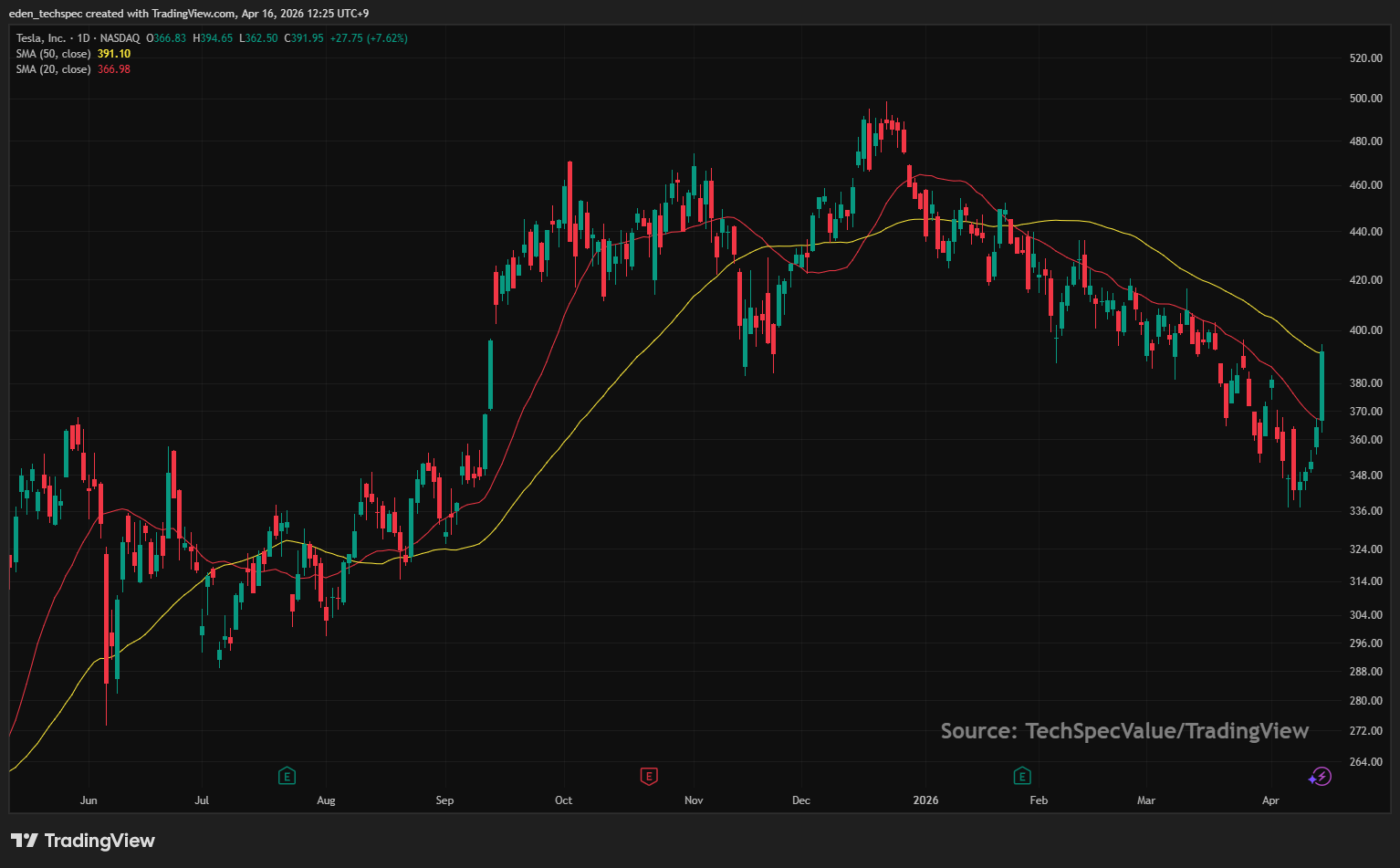
As of April 16, 2026, the technical landscape for TSLA presents a quintessential battlefield. Following the Q1 delivery miss, the stock experienced a severe correction, as evidenced by the clear downward cascade in the technical chart below.
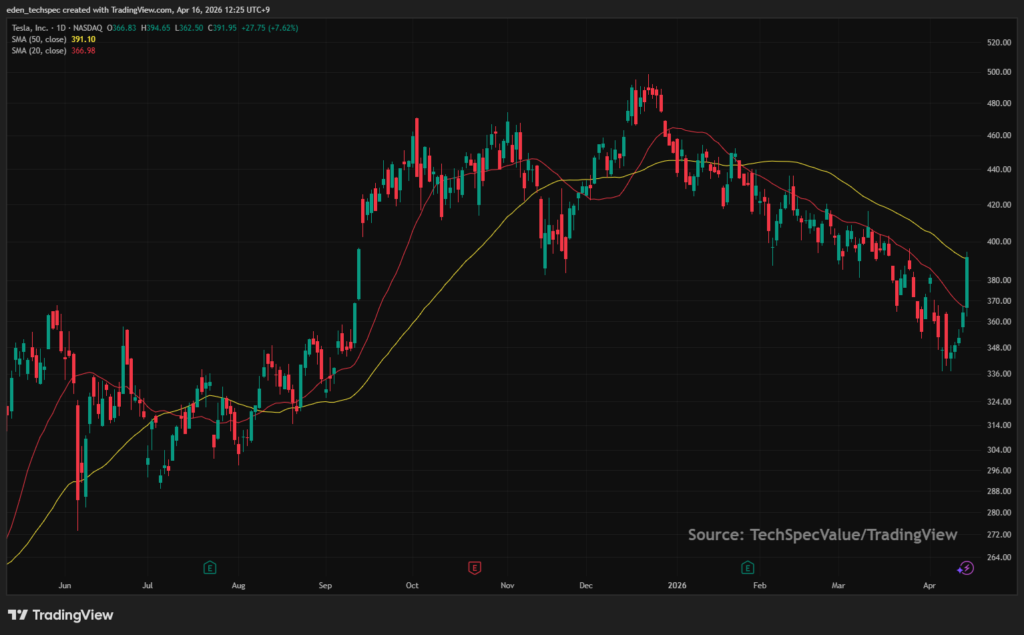
TSLA has been locked in a high-stakes test of a major structural support zone. While a significant bearish imbalance pushed the price to a intra-day low of $333, this triggered a classic “washout” event. Crucially, as the chart shows, this level acted as a launching pad for a violent +7.62% counter-trend rally in today’s session, reclaiming the psychological $350 line.
Despite this short-term “hammer” reversal candle forming on high relative volume, TSLA remains constrained beneath its 20-day Simple Moving Average (SMA, red line at $366.98) and well below the crucial 50-day SMA (yellow line at $391.10). The primary trend remains dominant to the downside, and a successful retest of the $350 support floor is required before a more constructive, larger-degree bounce can be initiated.
Re-evaluating the P/E: The AI Alpha and the April 22nd Catalyst
The valuation of TSLA continues to defy traditional automotive logic, with the current trailing P/E ratio sitting at approximately 338x. This elevated multiple is a clear reflection of the “AI Alpha” that institutional investors are pricing into TSLA stock. While legacy auto manufacturers trade at single-digit multiples, TSLA is being valued as an AI-infrastructure play, comparable to high-growth semiconductor giants.
All eyes are now on the April 22, 2026, earnings call, where market consensus expects TSLA to report an EPS of approximately $0.40 (Non-GAAP). A “beat and raise” scenario, fueled by the higher-than-expected 8.8 GWh energy deployment and FSD subscription growth, could provide the fundamental spark needed for TSLA to reclaim the $430 resistance level. Conversely, any further compression in automotive margins could lead to a violent re-rating of the TSLA multiple. The market is effectively in a “wait-and-see” mode, balancing the short-term vehicle delivery headwind against the long-term potential of the Cybercab and Optimus robotics segments.
7. Risk Factors and Final Investment Thesis for TSLA
Navigating the Tail Risks: China, Regulation, and CAPEX
Despite the technological breakthroughs, the bull case for TSLA in 2026 is balanced by significant “friction” points that every systems analyst must weigh. The primary headwind for TSLA remains the intensifying competition from Chinese giants like BYD and Xiaomi, who are not only matching Tesla’s price points but are outpacing it in the rapid iteration of smart-cockpit features. Furthermore, the global rollout of FSD v14 and the newly launched Cybercab face a complex patchwork of regulatory hurdles.
While Giga Texas celebrated the first Cybercab production units this quarter, federal safety standards in the U.S. and the RDW in Europe remain cautious regarding “unsupervised” Level 4 autonomy. There is also the persistent “Key Person Risk” associated with Elon Musk; his divided attention across SpaceX, X, and xAI, coupled with his high political visibility, continues to introduce a unique “volatility premium” to TSLA. Finally, the record-breaking $20.7 billion CAPEX planned for 2026—designed to fund the Cortex 2 AI supercomputer and the Terafab infrastructure—poses a short-term risk to free cash flow (FCF) stability if the ramp-up of Optimus Gen 3 experiences technical delays.
Final Conclusion: The Platform Transition Is Complete
In summary, the Q2 2026 outlook for TSLA suggests a company at the final stage of a profound metamorphosis. The “automotive manufacturing” narrative that defined the last decade is officially being replaced by an “AI, Robotics, and Energy Platform” framework. While the Q1 delivery numbers provided a short-term tactical dip, the underlying fundamentals—specifically the 48% growth in Energy Storage and the production-ready status of the Cybercab—indicate a business building massive long-term value. For the patient investor, the current consolidation near the $350 support level represents a rare opportunity to enter a dominant AI play before the high-margin “SaaS and Service” engine fully ignites.
TSLA is no longer just selling cars; it is selling the physical intelligence and energy infrastructure of the autonomous age. The April 22nd earnings call will likely be the definitive “prove-it” moment that determines if TSLA can reclaim its status as the world’s most valuable technology platform.
Further Reading:
- Amprius Technologies: The Explosive Growth Path to $30 (2026 Analysis)
- Iran War Aftermath: Explosive Survival Strategies for Investors
Related Content: