1. Introduction: Why the SoFi Dominance is Inevitable in 2026
The Great Migration from Legacy Finance to New Money
As we navigate the economic landscape of April 2026, the transition from “Old Money” traditional banking institutions to “New Money” Fintech Growth Stocks has reached a critical inflection point. For decades, the financial sector was dominated by monolithic banks burdened by aging physical infrastructure and siloed legacy systems. However, as the Federal Reserve initiates a more accommodative monetary cycle following the stabilization of inflation, the cost of capital is shifting, favoring agile, tech-first platforms over brick-and-mortar giants. SoFi Technologies (SOFI) represents the apex predator of this new ecosystem.
While the broader market remains fixated on superficial volatility, a systems-level engineering analysis reveals that Fintech Growth Stocks like SoFi have successfully weaponized high-interest environments to build robust balance sheets and are now poised to capture massive market share as credit conditions loosen. We are no longer discussing speculative “disruptors” with negative cash flows; we are analyzing the new structural backbone of global finance that has effectively swallowed the functions of traditional banking, making SoFi the primary engine of sector alpha.
Strategic Convergence of Profitability and Scalability
The primary reason Fintech Growth Stocks like SoFi demand immediate investor focus is the rare convergence of hyper-growth and disciplined profitability. In previous market cycles, the term was synonymous with “growth at any cost,” often leading to unsustainable burn rates. Today, the narrative has flipped. SoFi has moved past its nine consecutive quarters of GAAP profitability, proving that its vertically integrated model—combining a bank charter with high-margin financial software—creates a powerful flywheel effect. By internalizing the entire banking stack, SoFi captures value at every node of a transaction, a feat that legacy institutions cannot replicate without massive CAPEX.
For the modern portfolio, holding high-quality Fintech Growth Stocks like SOFI isn’t just a bet on technology; it’s a strategic hedge against the obsolescence of traditional financial intermediaries. The company has moved from the “hope” phase into the “execution” phase, where compounding earnings power becomes the primary driver of share price appreciation for savvy investors.
2. Business Overview: Engineering the Future of Financial Intermediation
SoFi Technologies: The Vertically Integrated Financial Super-App
To understand why SOFI is a leader among Fintech Growth Stocks, one must understand the concept of the “Financial Services Productivity Loop.” Founded on the premise of refinancing student loans, SoFi has evolved into a comprehensive digital bank that serves the entire lifecycle of a high-earner-not-rich-yet (HENRY) consumer. From an engineering perspective, SoFi’s true moat lies not just in its user interface, but in its ownership of the underlying tech stack via Galileo and Technisys.
By owning the core banking platform, SoFi eliminates the “middleman tax” that other neobanks must pay to third-party processors, a key differentiator for Fintech Growth Stocks in 2026. This vertical integration allows them to offer higher APYs on deposits while maintaining lower customer acquisition costs (CAC) through cross-selling. When a user joins for a high-yield savings account and subsequently opens a credit card or takes out a mortgage, the marginal cost of serving that customer drops to near zero, while the lifetime value (LTV) scales exponentially.
The B2B Engine: Galileo and Technisys
Beyond the consumer app, SoFi operates a massive B2B infrastructure that powers other Fintech Growth Stocks. Galileo and Technisys act as the “AWS of Fintech,” providing the backend for digital cards, payments, and core banking for third-party institutions. This segment provides a capital-light, recurring revenue stream that is decoupled from the fluctuations of the lending market.
In early 2026, the integration of new AI-driven risk assessment tools into this platform—such as the Nova Credit partnership for international credit data—has further widened SoFi’s technological lead. For a systems engineer, this represents the ultimate optimization of the global financial value chain. Once a financial institution integrates SoFi’s stack into their operations, the switching costs become prohibitive, ensuring long-term, high-visibility revenue streams. In the realm of Fintech Growth Stocks, SoFi’s ability to act as both a consumer bank and a technology provider creates a level of fundamental stability typically reserved for massive industrial conglomerates.
3. Revenue Analysis: Explosive Growth and the SoFi Inflection Point
Engineering the $1 Billion Quarterly Revenue Milestone
The most significant data point in the 2026 landscape is SoFi’s transition into a billion-dollar quarterly revenue powerhouse. In late January 2026, SoFi reported Q4 2025 net revenue of $1.013 billion, a monumental psychological and financial barrier that confirms its status as a top-tier choice among Fintech Growth Stocks. This 37% year-over-year surge was not driven by risky lending alone, but by a high-velocity expansion in Financial Services. From a systems perspective, SoFi has successfully decoupled its growth from the macro-lending cycle.
While traditional banks saw revenue stagnation due to shifting net interest margins, SoFi’s non-interest income—particularly fee-based revenue, which surged 53% to $443 million—grew as its 13.7 million members intensified their use of the “Super-App.” This is the “Productivity Loop” in action: every new member added in 2026 is joining a more mature ecosystem with lower marginal costs, ensuring that the 30% revenue growth projected for 2026 is both achievable and high-margin.
Diversified Income Streams: Lending vs. Fee-Based Revenue
A rigorous audit of the revenue architecture reveals that SoFi is no longer “just a lender.” Total originations reached a record $10.5 billion in the most recent quarter, but the real story lies in the diversity of the book. Personal loans remain the anchor ($7.5 billion), but home loans have doubled year-over-year, and student loan refinancing is seeing a massive resurgence as rates begin their descent in early 2026.
However, the most bullish signal for Fintech Growth Stocks is the surge in the Loan Platform Business (LPB), which now operates at an annualized origination pace of $15 billion of high-margin, capital-light revenue. By selling loans to partners like Fortress Investment Group while retaining the servicing rights, SoFi generates immediate fee income without straining its own balance sheet. This “capital-efficient” growth is exactly why institutional investors are upgrading SOFI, as it provides the scalability of a tech firm with the regulatory safety and deposit-funding of a national bank.
4. Earnings & Fundamentals: The 2026 Profitability Acceleration
The SoFi EPS “Rocket Ship” Forecast
If 2024 was the year of initial profitability, 2026 is officially the year of EPS acceleration for SoFi. Management has issued a bold guidance for $0.60 GAAP EPS for the full year 2026, a massive leap from the $0.13 reported in late 2025. This earnings power is supported by a projected $4.65 billion in adjusted net revenue.
For an analyst, the key metric is the Adjusted EBITDA, which is guided to hit $1.6 billion, representing an astonishing 52% to 60% growth rate. By using its own low-cost deposits—which reached a record $37.5 billion at the start of 2026—to fund loans, SoFi is essentially printing margin that non-bank fintechs cannot access. At a forward P/E of approximately 34x, the market is finally pricing SoFi as a high-efficiency cash flow machine rather than a speculative startup. This shift is the primary catalyst for the institutional “re-rating” we are seeing in the current quarter.
Scaled Efficiency and the 34% EBITDA Margin Goal
SoFi is operating at an efficiency frontier that defines the gold standard for Fintech Growth Stocks. Management’s 2026 outlook emphasizes a transition where net income margins are projected to approach the high-teens. This is driven by massive operating leverage; as fixed infrastructure costs for Galileo and Technisys are spread across a larger member base, every incremental dollar of revenue becomes more profitable.
The company’s 34% Adjusted EBITDA margin guidance for 2026 is a testament to this disciplined engineering. Unlike traditional banks burdened by physical branch costs, SoFi’s digital-only model allows for a “cost-to-serve” that is structurally lower. For the sophisticated investor, the lack of corporate debt and the consistent ability to generate record free cash flow make SoFi one of the most robust financial fortress stocks in the 2026 market, blending the safety of a bank with the upside of a high-growth tech titan.
5. 2026–2027 Projections: Navigating the Multi-Year Growth Trajectory
The Path to 20 Million Members and S&P 500 Inclusion
Looking toward the 2027 fiscal window, SoFi is positioned to experience a “compounding effect” that will likely lead to its inclusion in the S&P 500. With membership projected to exceed 20 million by 2027 (up from 13.7 million in early 2026), SoFi is no longer a niche player; it is becoming a top-tier national financial institution.
A key catalyst for this period will be the full-scale maturation of its “Financial Services Productivity Loop,” where the majority of revenue shifts from lending to capital-light fee-based services. As the Federal Reserve continues to normalize rates in 2026, the volume of student loan and mortgage refinancing is expected to surge, providing a massive tailwind for SoFi’s high-margin lending segments. This evolution ensures that SoFi is not just a growth play, but a structurally dominant force in the global digital economy for the next decade.
Galileo’s Evolution into the “AWS of Fintech”
The 2026–2027 roadmap for SoFi’s Technology Platform is defined by the global scaling of its cloud-native core. Galileo is increasingly being adopted by large-scale incumbent banks looking to modernize their aging infrastructure. By 2027, this segment is expected to represent a significantly larger slice of SoFi’s total revenue pie, justifying a “hybrid” valuation multiple—higher than a traditional bank but more stable than a pure SaaS company.
Furthermore, the integration of generative AI into Galileo’s conversational banking tools is set to reduce customer support costs for its B2B partners, creating a powerful incentive for migration. This transformation from a consumer app into a comprehensive financial infrastructure provider ensures that SoFi will remain the essential backbone of the digital banking revolution, capturing value from every corner of the financial ecosystem.
6. Technical Analysis & Risk Assessment: Navigating the 2026 Volatility
Chart Dynamics: Key Support and Resistance Levels
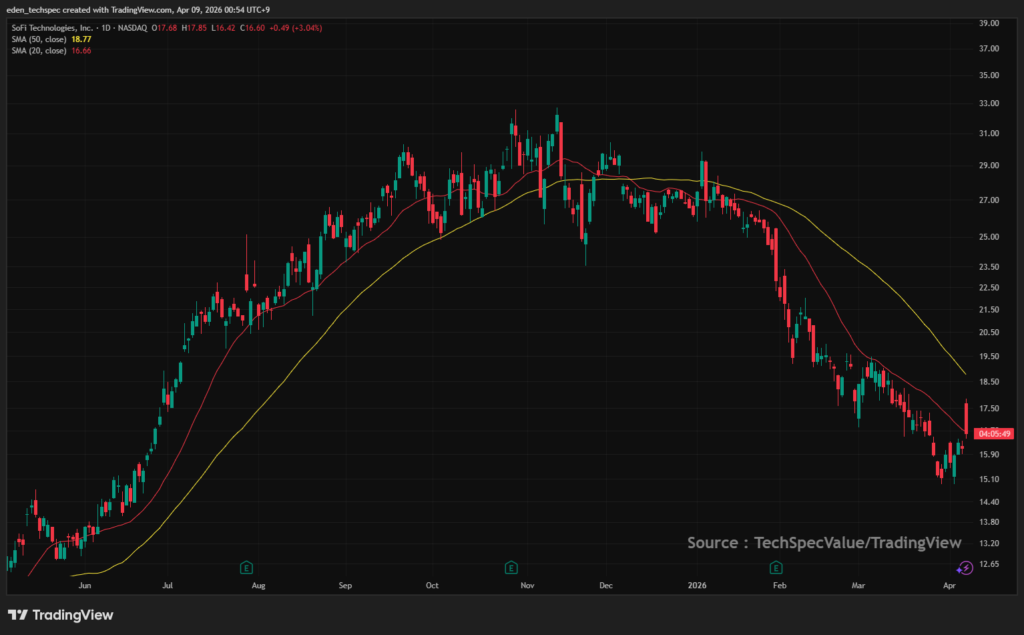
From a purely technical perspective, SoFi (SOFI) is currently navigating a high-stakes consolidation phase following a volatile start to 2026. After peaking near $32.73 in late 2025, the stock faced a sharp retracement, finding a secondary technical floor at $15.85 as of April 2026. For a systems engineer, this price action represents a classic “re-testing” of institutional support.
The immediate psychological and technical pivot sits at $20.00. A sustained daily close above this level, backed by high volume, would likely clear the “Moving Average Cluster” (the 20-day and 200-day SMAs currently hovering near $23) and signal a trend reversal toward the **$25.00** consensus target. Conversely, the $14.50 zone remains the critical line in the sand; a breakdown below this would invalidate the current bullish structure and potentially lead to a revisit of the 52-week lows.
Risk Inventory: The “Muddy Waters” Factor and Credit Quality
The primary risk for Fintech Growth Stocks like SoFi in 2026 is the recent “short-seller” scrutiny. The March 2026 Muddy Waters report alleged aggressive accounting and credit risk, causing significant short-term turbulence. While SoFi management has dismissed these claims as a “fundamental misunderstanding” of their banking financials, investors must monitor the Q1 2026 personal loan net charge-off rate (scheduled for release on April 29, 2026).
If the rate remains stabilized near the 2.80% level seen in late 2025, the bear thesis will likely evaporate. However, any material spike toward 4% or 5% would indicate that high rates are finally stressing SoFi’s “HENRY” (High Earner, Not Rich Yet) customer base. Additionally, the regulatory landscape regarding fintech capital requirements remains a moving target that requires disciplined tracking to ensure SoFi’s margin expansion remains unimpeded.
7. Conclusion: Why the Digital Banking Pivot is Inevitable
The Synthesis of Strategy and Execution
The conclusion of our deep-dive analysis is clear: the transition of SoFi from a speculative fintech to a scaled financial powerhouse is nearing completion. By successfully navigating the “Valley of Death” in 2023 and the short-seller attacks of early 2026, SoFi has emerged as a resilient, highly profitable machine.
It has fundamentally redefined what it means to be a “bank” for the digital native, combining the high-growth DNA of a tech firm with the stable, deposit-funded balance sheet of a traditional institution. In an investment environment where cash flow is king and technical moats are the only protection against AI-driven disruption, SoFi represents the gold standard of Fintech Growth Stocks. It is no longer just an alternative to legacy banks; it is the new structural benchmark for the industry.
Final Investment Posture: Capturing the $30+ Re-rating
For the tactical investor, the current 2026 pullback to the mid-$15 to high-$17 range represents a high-conviction entry point for what we expect to be a significant “re-rating” toward the $30.00 mark by year-end. If SoFi delivers on its $0.60 EPS guidance, the stock will no longer be valued as a risky startup but as a high-margin technology platform.
The combination of explosive member growth, the capital-light scaling of Galileo, and the massive efficiency gains from its bank charter creates a “perfect storm” for capital appreciation. While volatility is guaranteed in the world of Fintech Growth Stocks, the engineering depth and fundamental strength of SoFi’s “Productivity Loop” suggest that those who buy the dip today will be well-positioned to capture the most significant financial restructuring of the 21st century.
Further Reading:
- The Future of Global Payments 2026 – KPMG Insights
- Digital Banking Adoption Curve – Federal Reserve Report
Related Content: