
1. Background of the Early March U.S. Market Slump (Nasdaq Shock)
March 6, 2026: The Decisive Reason for the Nasdaq Shake-up
As of March 6, 2026, the global financial ecosystem is reeling from a confluence of systemic shocks that have culminated in a significant Nasdaq crash event. From an engineering perspective, the market’s structural integrity was compromised by a dual-pressure system: deteriorating macroeconomic fundamentals and escalating geopolitical friction. The primary catalyst was a staggering miss in the February employment data, which sent shockwaves through high-growth sectors that had previously priced in a “soft landing” scenario. When we analyze the telemetry of this sell-off, it becomes evident that the “Goldilocks” regime—where bad economic news was once cheered as a precursor to Fed pivots—has officially shifted. The integration of high-frequency trading algorithms reacting to the breach of psychological support levels at 23,000 accelerated the downside momentum. Furthermore, the intensification of supply chain bottlenecks in the semiconductor corridor, driven by renewed trade restrictions and maritime insecurity, has forced a re-evaluation of the AI-driven premium that sustained the Nasdaq throughout the previous fiscal year. This isn’t merely a technical correction; it is a fundamental repricing of risk as the market realizes that the cushion of corporate earnings may not be thick enough to absorb the impact of a rapidly cooling labor market alongside stubborn input costs.
Market Sentiment Shifts to ‘Bad is Bad’
The psychological framework governing Wall Street has undergone a radical transformation, moving from a “Bad is Good” paradigm to a sobering “Bad is Bad” reality. Historically, weak labor data suggested a cooling economy that would prompt the Federal Reserve to slash interest rates, thereby boosting the discounted cash flow (DCF) models of growth-heavy tech stocks. However, in the current 2026 environment, the narrative has soured. The latest Non-Farm Payrolls (NFP) report indicated such a profound deceleration that investors are no longer looking at the potential for lower rates; instead, they are fixated on the looming specter of a hard recession. When employment figures falter to this degree, it signals a collapse in consumer discretionary spending power—the very engine that drives the revenue growth for the “Magnificent 7” and the broader SaaS ecosystem. In my capacity as an analyst, I observe that the correlation between Treasury yields and tech valuations has decoupled in a dangerous way. Usually, falling yields provide a tailwind for the Nasdaq, but currently, yields are dropping because of flight-to-safety, while equities are simultaneously crashing because of growth fears. This synchronized decline indicates a total loss of confidence in the “soft landing” thesis, leaving the Nasdaq vulnerable to further liquidation as institutional desks move toward capital preservation over capital appreciation.
Big Tech Regulation and Downward Pressure on the AI Sector
The structural pillars of the 2025 bull run—specifically NVIDIA (NVDA), AMD, and the broader AI infrastructure cohort—are now facing a severe stress test. The Nasdaq crash is intensified by a shifting regulatory landscape where the U.S. government has expanded export controls on high-end H200 and MI400 series chips, citing national security concerns amid heightened global tensions. This regulatory friction directly impacts the “terminal value” of these tech giants, as the total addressable market (TAM) is effectively being partitioned. From a systems analysis view, the AI sector is experiencing a “diminishing returns” phase where the massive capital expenditures (CapEx) of hyperscalers are no longer resulting in immediate, exponential revenue growth. Instead, these companies are grappling with skyrocketing energy costs for data centers and a cooling demand for enterprise AI integrations as corporate budgets tighten. When the “engine” of the index—AI—begins to sputter due to both political and economic headwinds, the entire index loses its lift. This paragraph marks the realization that the AI premium was perhaps a “perfect weather” valuation that cannot survive the storm of 2026, leading to a massive rotation out of momentum stocks into defensive postures.
Summary of the Current Market Interplay
To summarize the immediate landscape, the March 2026 market is characterized by a “correlation of one,” where almost all risk assets are being sold in tandem. We are witnessing the convergence of a slowing labor market, which threatens the top-line revenue of tech companies, and a geopolitical environment that threatens the supply chain and bottom-line margins. This is a classic “pincer movement” on equity valuations. The technical damage is profound, with the Nasdaq slicing through its 50-day moving average with high volume, suggesting that institutional “smart money” is actively de-risking rather than “buying the dip.” As a former systems engineer, I see this as a system-wide reboot. The previous parameters of high liquidity and low volatility have been replaced by high volatility and liquidity fragmentation. The current Nasdaq crash is the market’s way of finding a new equilibrium—a “fair value” that accounts for a world where growth is no longer a given and risk is no longer free. The coming sessions will be critical in determining whether this is a controlled descent or a catastrophic failure of the current market structure, as we look toward the next set of inflation data to provide a potential, albeit unlikely, lifeline for the bulls.
2. Macroeconomic Double Whammy: The Specter of Stagflation
Employment Shock: The Warning Siren of February’s Non-Farm Payrolls
The latest non-farm payroll data for February 2026 has sent a chilling message through the financial markets, marking a definitive structural failure in the labor engine. Total employment unexpectedly added a mere 92,000 jobs, a catastrophic deviation from the modest growth expectations and the sharpest deceleration in over a year. As a systems analyst, I view this not just as a statistical miss, but as a breakdown of the economic feedback loop that sustained the post-pandemic recovery. The unemployment rate has ticked up to 4.4%, and while some may point to sector-specific strikes as a temporary distortion, the underlying trend in information technology and professional services remains decisively downward. This structural rot is particularly concerning because it indicates that the aggressive tightening cycle of 2024–2025 is finally catching up with the real economy. When the “engine” of the U.S. consumer—the job market—stalls, the high-valuation models of the Nasdaq crash lose their foundational support. We are seeing a “Sahm Rule” warning light flickering, suggesting that the risk of a hard landing has transitioned from a tail-risk to a baseline probability, forcing a violent de-risking phase across global institutional portfolios.
Oil Surges Past $90 and the Re-ignition of Inflation
Simultaneously, the energy complex has evolved into a secondary front of economic warfare, complicating the Federal Reserve’s path forward. Following the geopolitical escalations in late February, specifically involving maritime security threats in the Middle East, WTI and Brent crude have surged past $90 per barrel, with intraday spikes testing the $95 level. The potential for a prolonged blockade of key maritime choke points like the Strait of Hormuz has reintroduced an acute “geopolitical risk premium” that the market had largely ignored during the disinflationary narrative of 2025. This is the textbook definition of a supply-side shock: it is inflationary because it raises input costs for everything from global logistics to AI data center cooling, yet it is contractionary because it acts as an immediate tax on the already-weakened consumer. For the Federal Reserve, this creates a “checkmate” scenario. They cannot easily cut rates to stimulate the failing labor market without risking a hyper-inflationary spiral in energy and commodity prices. This stagflationary pincer—falling growth paired with rising costs—is the ultimate catalyst for the current market instability, as it destroys the “Goldilocks” environment that growth investors require for long-term capital allocation.
The Fed’s Dilemma and the Uncertainty of the Interest Rate Path
The convergence of a cooling labor market and heating inflation puts Chairman Jerome Powell and the Federal Open Market Committee (FOMC) in an unprecedented 2026 predicament. Historically, the Fed has the luxury of choosing between fighting inflation or supporting employment; today, they are forced to confront both simultaneously with conflicting tools. If the Fed pivots to aggressive rate cuts to prevent the 4.4% unemployment rate from spiraling into a deep recession, they risk de-anchoring inflation expectations as energy costs remain high. Conversely, if they maintain a “higher for longer” stance to suppress the $90 oil-induced price spikes, they might inadvertently crush the remaining life out of the tech-heavy Nasdaq. This lack of a clear “policy put”—the historical tendency of the Fed to rescue the market—is precisely why the Nasdaq crash has been so relentless. Investors are realizing that the safety net has been removed. The uncertainty surrounding the March FOMC dot plot and the potential for “higher for longer” despite weak growth has led to a massive liquidity vacuum, as market participants wait for a definitive signal from the central bank that simply may not come in time to save current valuations.
3. Assessing U.S. Economic Vitality via the S&P 500 (SPX)
Why Energy (XLE) Was the Lone Survivor Among 11 Sectors
The divergence within the S&P 500 sectors in early March 2026 provides a clear map of where “smart money” is seeking shelter during this Nasdaq crash. While the broader index has struggled, the Energy (XLE) sector has surged, posting significant gains as investors rotate into “heavy assets” and inflation hedges. This rotation is a classic defensive maneuver; when the “invisible” software-driven economy faces valuation compression due to rising discount rates and cooling growth, capital flows into the “visible” economy of physical commodities and energy infrastructure. Interestingly, we are seeing the rise of a new investment philosophy focusing on tangible yield over speculative growth. Conversely, the Consumer Discretionary and Technology sectors have been the primary laggards. The reasoning is purely analytical: higher fuel prices and a softening labor market are the two most potent poisons for consumer-facing companies. The market is effectively signaling that the “growth at any price” era has hit a hard ceiling, replaced by a desperate search for margin stability and reliable cash flows in an increasingly volatile energy landscape.
Rising Costs Eroding Corporate Profit Margins
From the perspective of a systems engineer, a corporation is a processing unit where input costs must be lower than output value to maintain equilibrium. Currently, S&P 500 companies are facing a “margin squeeze” from both ends of the spectrum. On the input side, the spike in crude oil to $90 and the subsequent rise in logistics and electricity costs are inflating the “Cost of Goods Sold” (COGS). On the output side, the February employment shock suggests that the end consumer is losing the discretionary power to absorb price hikes. This leads to “negative operating leverage,” where even a slight dip in revenue results in a disproportionately large drop in net income. For the tech-heavy Nasdaq, which relies on high-margin software-as-a-service (SaaS) models, the secondary effect is a reduction in enterprise spending. When a Fortune 500 company sees its margins thinning due to energy costs, the first budget it cuts is the “innovation” or “AI integration” budget. This creates a ripple effect where the projected earnings growth for the tech sector—previously the primary justification for high P/E ratios—is being revised downward across the board.
The Collapse of the 100-Day Moving Average Support
From a technical engineering standpoint, the S&P 500’s breach of its 100-day moving average (approximately 6,836) represents a critical structural failure. Throughout much of the previous fiscal year, this line acted as a reliable “floor” where institutional buyers would step in to provide liquidity. However, the high-volume breakdown below the 6,800 psychological level has shifted the market’s internal mechanics from “buy the dip” to “sell the rip.” This level was more than just a line on a chart; it represented the collective confidence of the market in a 2026 earnings recovery. By cracking this support, the index has opened the trapdoor toward the 200-day moving average, a level that often dictates the boundary between a correction and a bear market. My analysis of order flow suggests that systematic trend-following funds have flipped to net-short positions, further accelerating the downward pressure. When the broad market benchmark loses its technical integrity, it creates a feedback loop of forced liquidations and margin calls, particularly for retail traders who were heavily leveraged in high-beta AI names. The current chart structure suggests that until the S&P 500 can recapture and hold the 6,840 level, any upward movement should be viewed as a temporary “dead cat bounce.”
| Sector | YTD Return (%) | Energy Sensitivity | Margin Outlook |
|---|---|---|---|
| Energy (XLE) | +25.0% | Inverse | Expanding; High FCF |
| Technology (XLK) | -8.5% | Moderate | Squeezed by AI CapEx |
| Utilities (XLU) | +10.2% | Low | Stable; Yield Play |
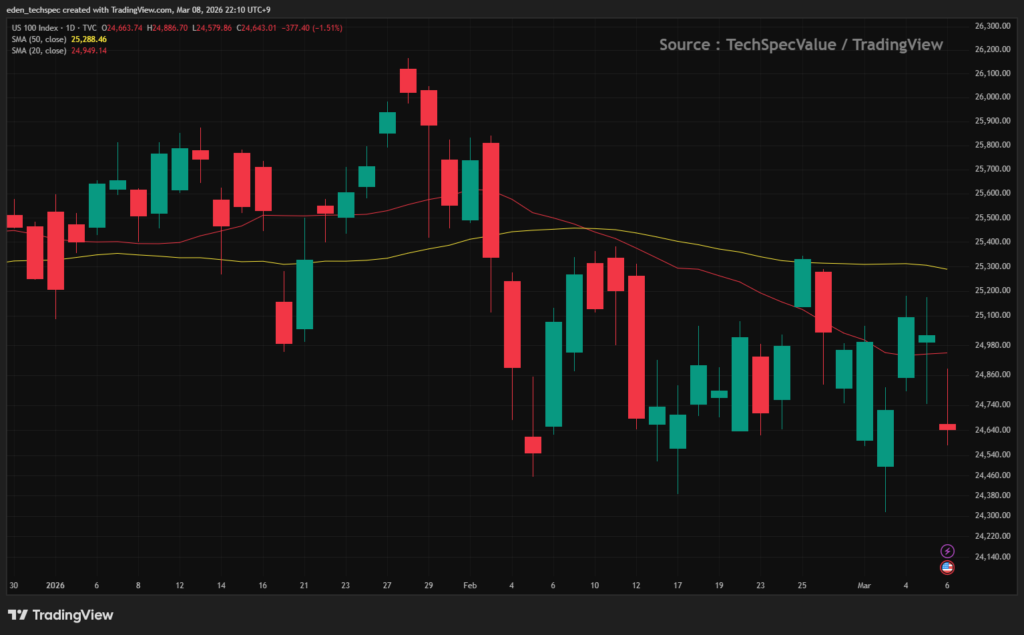
4. Analysis of the Nasdaq (IXIC) Psychological Maginot Line
The First Line of Defense at 22,500 and the Trend Lifeline
From the perspective of a systems engineer, every complex structure has a “yield point” where stress leads to permanent deformation. For the Nasdaq crash of 2026, that critical threshold is the 22,500 level. This zone represents a high-volume node where significant institutional accumulation occurred during the late 2025 AI rally. For a short-term rebound to remain a viable thesis, the index must defend this line with absolute conviction. However, the current telemetry is concerning; we are seeing “exhaustion gaps” on the daily charts, suggesting that the bulls who previously defended every 2% dip have retreated to the sidelines. If the Nasdaq fails to reclaim this 22,500 “waterline” within the next three trading sessions, the market’s internal momentum shifts from a standard correction to a systemic breakdown. This level isn’t just a number; it is the “trend lifeline” that separates a healthy, albeit volatile, bull market from a transition into a prolonged bearish regime where the cost of capital permanently reprices upward.
The 120-Day Moving Average and the 22,000 Symbolic Meaning
As we descend deeper into the price discovery phase, the 120-day moving average (approximately 22,000) emerges as the ultimate psychological Maginot Line. In the world of algorithmic trading, the 120-day MA often serves as the “medium-term sentiment filter.” A breach of this level typically triggers a “gamma flip” in the options market, where market makers are forced to sell the underlying index to hedge their delta exposure, creating a self-fulfilling prophecy of downward pressure. When we overlay this with the VIX (Volatility Index), which is currently testing the 25-point resistance, the 22,000 mark becomes the trigger for “panic selling.” If the Nasdaq slices through 22,000 on high volume, it signals that the narrative has shifted from “valuation concern” to “liquidity crisis.” For the retail investor heavily concentrated in levered ETFs like TQQQ, this is the danger zone where margin calls become mathematically inevitable, potentially leading to a “flash crash” scenario as automated liquidation protocols override human discretion.
Valuation Floors and the 200-Day Moving Average Final Bastion
Despite the prevailing gloom, every Nasdaq crash eventually finds its “fair value” equilibrium. As a data-driven analyst, I am closely monitoring the 200-day moving average, currently hovering near the 21,200 range. This is the “final bastion” of the long-term structural uptrend that began in 2023. At this level, the forward P/E ratios of the Nasdaq’s core constituents—the mega-cap tech leaders—begin to look historically attractive, even when accounting for a 5% terminal interest rate. This is where “value-oriented” institutional capital, such as sovereign wealth funds and pension funds, typically steps in to provide a hard floor. We are looking for a “capitulation wick” at this level—a sharp, high-volume sell-off followed by a rapid recovery—to signal that the weak hands have been thoroughly shaken out. While the 200-day average represents a significant 10-15% haircut from the recent highs, it also offers the most compelling risk-reward entry point for long-term investors who believe in the enduring productivity gains of the AI era, provided the macro-environment stabilizes.
| Technical Marker | Price Level | Strength | Implication of Breach |
|---|---|---|---|
| 1st Support (Psychological) | 22,500 | Moderate | Shift to neutral-bearish trend |
| 120-Day Moving Average | 22,000 | Strong | Triggers systematic “Gamma” selling |
| 200-Day Moving Average | 21,200 | Critical | Final bastion for long-term bull thesis |
5. Three Key Economic Indicators to Watch Right Now
The Trajectory of the 10-Year Treasury Yield (TNX)
From a systems engineering perspective, the 10-year Treasury Yield (TNX) serves as the global discount rate—the fundamental “gravity” that dictates the valuation of every financial asset. As we navigate this Nasdaq crash, the 4.2% threshold has become the critical battleground for tech equity multiples. When yields climb above this level, the present value of future cash flows for high-growth companies diminishes rapidly, leading to the aggressive “multiple compression” we are witnessing in SaaS and AI infrastructure stocks. My current analysis suggests a dangerous decoupling: while yields are rising due to “term premium” and inflation fears, equity prices are falling due to growth concerns. This is a “tightening of financial conditions” in its purest form. Investors must monitor the 10-year yield with clinical precision; a sustained move toward 4.5% would likely invalidate current support levels for the Nasdaq, as it would signal that the bond market is pricing in a permanent shift to a higher-inflation regime that tech earnings, despite their AI tailwinds, simply cannot outpace.
The Dollar Index (DXY) and Global Capital Flow Dynamics
The U.S. Dollar Index (DXY) is currently acting as a “wrecking ball” for international liquidity, further exacerbating the domestic market downturn. In times of extreme geopolitical stress and “employment shocks,” the dollar typically benefits from a “flight to safety” bid. However, a surging DXY creates a dual-threat for the S&P 500’s multinational constituents: it makes American exports more expensive abroad while simultaneously devaluing international earnings when translated back into USD. Currently testing the 106.5 resistance zone, the DXY is signaling a massive “liquidity vacuum” where capital is being pulled out of emerging markets and risk-on assets to hide in the perceived safety of greenbacks. For the Nasdaq, which derives a significant portion of its revenue from global enterprise software deployments, a runaway dollar is a direct hit to top-line growth. I am watching for a “peak dollar” signal—a reversal in the DXY—as the primary prerequisite for a sustainable bottom in tech stocks; until the dollar stabilizes, the “carry trade” unwinding will continue to provide a mechanical headwind for equity markets.
VIX and the Entrenchment of Market Volatility
The CBOE Volatility Index (VIX), often referred to as the market’s “fear gauge,” has officially broken out of its low-volatility regime of 2025, currently oscillating between 22 and 28. As an analyst, I focus on “volatility clustering,” where high volatility tends to beget even higher volatility. The entrenchment of the VIX above the 25 level suggests that institutional “delta hedging” is now the primary driver of daily price action, rather than fundamental valuation. This creates a “choppy” environment where 2% intraday swings become the norm, making it nearly impossible for retail traders to maintain leveraged positions without being “stopped out.” To identify a market bottom, we are looking for a “volatility crush”—a scenario where the market stops falling even as bad news continues to hit the wires. Until the VIX retreats below the 20-day moving average and stabilizes, the Nasdaq crash remains in an “active distribution” phase. Tactical investors should treat any rally during a VIX spike as a liquidity event to raise cash, rather than a signal to aggressively re-enter the fray, as the “gamma” risk remains skewed heavily to the downside.
| Indicator | Bullish Threshold | Bearish Threshold | Current Status (March 2026) |
|---|---|---|---|
| US 10Y Yield (TNX) | < 3.8% | > 4.2% | Bearish (Testing 4.25%) |
| Dollar Index (DXY) | < 102.0 | > 106.0 | Bearish (Surging to 106.5) |
| Fear Gauge (VIX) | < 18.0 | > 25.0 | Volatile (Testing 28.0) |
6. Sector-Specific Response Strategies for Investors
Defensive Stocks and Dividend ETFs Shining in a Downturn
In the engineering of a resilient portfolio, the “redundancy” factor is often found in high-quality cash flows. As the Nasdaq crash continues to devalue growth-heavy assets, institutional capital is pivoting toward the “safety of yield.” Dividend-focused ETFs such as SCHD (Schwab US Dividend Equity) and JEPI (JPMorgan Equity Premium Income) have become essential shock absorbers in this environment. These vehicles prioritize companies with robust balance sheets and consistent payout histories, effectively creating a “valuation floor” that high-beta tech stocks currently lack. From an analytical perspective, when the cost of capital rises, the market stops paying for “potential” and starts paying for “certainty.” By reallocating a portion of the portfolio into these defensive instruments, investors can mitigate the drawdown impact while capturing a steady stream of income that can be reinvested when the broader market eventually finds its footing. This isn’t just about playing defense; it’s about ensuring the portfolio has the liquidity to survive a “prolonged winter” in the tech sector.
Short-term Trading Viability in Energy and Commodity Sectors
Given the current “stagflationary pincer,” the Energy (XLE) and Materials sectors offer a unique tactical hedge against the broader market’s malaise. With oil testing the $90-95 range due to geopolitical friction, energy producers are experiencing an immediate expansion in free cash flow, decoupling them from the technical decay of the S&P 500. For the active trader, this creates a “long energy, short tech” relative value opportunity. However, it is vital to treat these as “tactical trades” rather than “structural holds.” As a former systems engineer, I recognize that high energy prices eventually lead to “demand destruction,” which can trigger a sharp reversal once the global economy slows enough to reduce consumption. Therefore, the strategy involves using energy stocks to offset Nasdaq crash losses in the short term, while maintaining tight stop-losses. This “geopolitical hedge” allows an investor to stay in the game without being fully exposed to the catastrophic downside of the semiconductor or software industries during this period of heightened maritime and supply-side risk.
Securing Cash Reserves and the Art of Fractional Buying
The most sophisticated tool in an analyst’s toolkit during a crisis is not a complex algorithm, but “the patience of a manager.” In a high-volatility regime, the most dangerous move is to “catch a falling knife” by deploying all available capital at the first sign of a rebound. Instead, the current 2026 climate dictates a “staged deployment” or fractional buying strategy. By maintaining a high cash position—upwards of 20-30%—investors preserve the “optionality” to buy at significantly lower levels if the Nasdaq tests its 200-day moving average. We are looking for “price stability” rather than “price action.” This means waiting for a series of higher lows and a contraction in the VIX before committing significant capital back into AI or growth names. This disciplined approach ensures that you are not wiped out by a secondary “liquidity gap” and allows you to build a position in world-class companies at “fire sale” valuations. Remember, in a Nasdaq crash, the goal is not to be the first one to buy the bottom, but the one who still has capital left when the bottom is finally confirmed by the data.
7. Conclusion: Data Will Ultimately Dictate the Direction
Next Week’s CPI Announcement as the Major Inflection Point
From a systems analysis perspective, the upcoming Consumer Price Index (CPI) release on March 11, 2026, represents the most critical data input for the market’s recalibration. While the recent Nasdaq crash was triggered by employment fears, the path toward a sustainable bottom is blocked by “sticky” inflation. If the February CPI figures exceed the 2.6% forecast—fueled by the recent $90 oil spike—the market will likely price in a “worst-case” stagflationary scenario. Conversely, a cooling inflation print would provide the Federal Reserve with the necessary “policy space” to address the labor market’s weakness. As an analyst, I advise looking past the headline number and focusing on “Supercore” inflation (services excluding housing and energy). This metric will reveal whether the inflationary pressures are truly systemic or merely a transient byproduct of geopolitical friction. Until this data is processed, the Nasdaq will likely remain in a state of high-entropy volatility, as institutional algorithms wait for a definitive signal to either resume the sell-off or initiate a relief rally.
Eyes on the March FOMC and Powell’s Rhetoric
The FOMC meeting on March 17-18, 2026, looms as the definitive event that will set the tone for the second quarter. The market is currently paralyzed by a lack of clarity regarding the “Fed Put”—the level at which the central bank will intervene to support the economy. In his upcoming press conference, Chairman Jerome Powell must navigate a narrow corridor: he must acknowledge the cooling labor market without signaling a panic that could further de-anchor inflation expectations. Investors should pay close attention to the updated “Dot Plot” (Summary of Economic Projections). Any shift toward fewer rate cuts in 2026 despite the employment shock would be viewed as a “hawkish mistake,” potentially sending the Nasdaq toward its 200-day moving average. However, if Powell emphasizes a data-dependent, balanced approach that prioritizes financial stability, we may finally see the “volatility crush” required for a market turnaround. The March FOMC is not just about interest rates; it is about the Fed’s credibility in a rapidly shifting 2026 macro-regime.
The Vitality of ‘Reactive Positioning’ over Prediction
In the world of engineering, we rely on “closed-loop” systems that adjust based on real-time feedback. Successful investing in 2026 requires a similar mindset: reactive positioning over predictive gambling. We are currently in a phase where the “macro” is overriding the “micro,” meaning individual company fundamentals are being ignored in favor of broad economic shifts. Therefore, the most prudent strategy is to wait for the confirmation of a bottom rather than trying to guess its exact coordinate. This involves watching for a “divergence” where the Nasdaq stops making new lows even as the news cycle remains negative. By adopting a “lagging” approach—waiting for the CPI and FOMC data to be fully digested—you trade the potential for a few extra percent of profit for the security of a confirmed trend. In this high-stakes environment, protecting your principal is the primary objective. Once the data clarifies the Fed’s path and the inflation trajectory, the market will offer a much clearer entry point for the next phase of the 2026 AI and technology cycle.