
1. Goldilocks Arrival: The Precision of Economic Equilibrium
Deciphering the CPI 2.4% Milestone and Corporate Margin Expansion
The arrival of the 2026 Market Outlook Goldilocks economy represents a profound structural recalibration that global financial markets have anticipated for nearly three intense years. As a systems engineer, I view the Consumer Price Index (CPI) not merely as a lagging statistical indicator, but as a high-fidelity thermal sensor for the entire macroeconomic engine. At a steady 2.4% anchor point, the “heat” of inflation is no longer melting the precision gears of industrial production, yet the “cold” of deflationary stagnation remains strategically at bay. This precise equilibrium, a cornerstone of our 2026 Market Outlook, allows for an unprecedented and predictable cost-accounting environment that is absolutely vital for long-term capital expenditure (CapEx) planning. When inflation was volatile between 2022 and 2024, corporations were forced into a defensive, “low-power” mode—hoarding cash, cutting R&D, and implementing hiring freezes to buffer against supply chain shocks and labor cost spikes. Today, in this 2026 Market Outlook era, that friction has effectively vanished. We are observing a synchronized stabilization where input costs—from raw materials to energy—are plateauing at sustainable levels while final consumer demand remains remarkably resilient. This creates a powerful “vacuum effect” for corporate profit margins; as the cost of goods sold (COGS) stabilizes, every incremental gain in operational efficiency is amplified. These efficiency gains, often driven by the first widespread wave of generative AI integration into supply chain logistics, are dropping straight to the bottom line. This is the fundamental bedrock of the 2026 Market Outlook: a definitive return to high-quality, margin-driven earnings growth. Unlike the previous cycle, this growth is not artificially inflated by reactionary price hikes that alienate consumers, but is instead organically fueled by price stability and technological optimization, signaling a mature and sustainable bull market phase for the decade ahead.
The Liquidity Catalyst: Why Interest Rate Normalization Changes the Game
The secondary, yet equally powerful effect of this Goldilocks arrival within the 2026 Market Outlook is the restoration of the global “hurdle rate” to a rational, productive level. During the high-interest-rate regime of 2023-2024, the opportunity cost of holding equities was prohibitively high compared to the “risk-free” yields of short-term treasuries. However, as we progress through the 2026 Market Outlook timeline, the Federal Reserve’s decisive pivot toward a neutral rate environment acts as a massive, high-pressure release valve for sidelined capital. This normalization is not merely about making corporate borrowing marginally cheaper; it is about a fundamental re-rating of equity valuations across the board. In my analytical models, when the discount rate used in discounted cash flow (DCF) calculations drops, the net present value (NPV) of future earnings—especially for high-duration growth firms in the tech and biotech sectors—expands at an exponential rate. We are currently witnessing a historic migration of capital as trillions of dollars flow out of money market funds, which hit record-breaking peaks in previous years, and back into the high-velocity equity ecosystem. This relentless influx of institutional liquidity provides a solid “structural floor” for the market, ensuring that any minor technical pullbacks are immediately met with aggressive buying from pension funds and sovereign wealth entities. The value proposition of the 2026 Market Outlook is remarkably clear: the macro-environment has shifted from a reactive state of “survival, hedging, and capital preservation” to a proactive state of “expansion, deployment, and aggressive growth.” For the disciplined and data-driven investor, this transition signifies that the macro-tailwinds are finally, and decisively, stronger than the geopolitical headwinds, creating a compounding wealth effect that will likely define the entire second half of the 2020s.
| Indicator | 2024 Actual | 2026 Outlook (Est.) | Impact Sentiment |
|---|---|---|---|
| CPI (Inflation) | 3.1% | 2.4% | Highly Positive |
| Fed Funds Rate | 5.25% – 5.50% | 3.25% – 3.50% | Expansionary |
| GDP Growth | 2.1% | 2.8% | Steady Growth |
2. Exponential AI Growth: From Infrastructure to Monetization
The NVDA Foundation and the Standardization of Global Data Centers
If the previous section of our 2026 Market Outlook was dedicated to the “atmospheric environment” of the economy, then Part 2 is strictly about the “high-performance engine” driving the ascent. The current 2026 Market Outlook is fundamentally inseparable from the long-awaited maturation of Artificial Intelligence infrastructure. For the past several cycles, the market narrative was almost exclusively dominated by the “arms dealers”—specifically NVIDIA (NVDA) and the specialized semiconductor supply chain that provided the raw processing power for the LLM (Large Language Model) revolution. However, as we move through the first half of 2026, we have reached a critical state of “Infrastructure Completion.” The massive, multi-year buildup of H100, H200, and the revolutionary Blackwell architectures across global hyperscale data centers has finally created a standardized, ubiquitous computational layer. This phase in the 2026 Market Outlook is strikingly analogous to the laying of undersea fiber-optic cables in the late 1990s; the physical tracks are now laid, and the “Great Awakening” refers to the massive activation of this latent hardware potential. We have moved decisively past the speculative “Gold Rush” phase where investors merely asked, “Who is buying the chips?” and entered the high-stakes execution phase where we analyze, “What is being built on them?” The sheer scale of this distributed computational power has reached a critical mass where the latency of AI reasoning has dropped to near-zero, enabling sophisticated, real-time autonomous agents to handle complex B2B workflows without human intervention. This fundamental infrastructure maturity, a key pillar of the 2026 Market Outlook, ensures that the massive capital expenditures (CapEx) of the “Magnificent Seven” are finally yielding a Return on Invested Capital (ROIC) that not only justifies but actively supports their multi-trillion-dollar market valuations.
The Software Explosion: Subscription Revenue and the SaaS Evolution
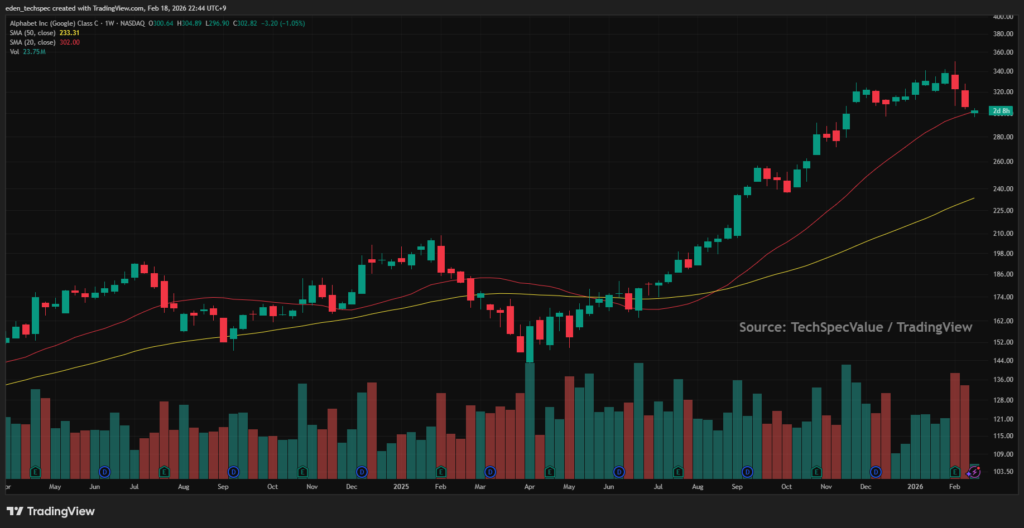
Perhaps the most transformative development within the 2026 Market Outlook is what I call the “Great Software Pivot.” While the hardware giants spent the last few years providing the foundation, the massive software conglomerates—led by Microsoft (MSFT), Google (GOOGL), and Adobe—are now aggressively harvesting the fruits of that labor. We are witnessing a definitive transition from “AI as a gimmick” to “AI as the core product.” This explosion in high-margin subscription-based revenue, a primary driver of the 2026 Market Outlook, is fueled by the reality that AI agents are no longer mere “chatbots”; they are high-functioning “copilots” capable of performing high-value professional labor. This shift is fundamentally rewriting the unit economics of the entire software industry. Instead of the traditional model of selling a “seat” or a license for a fixed price, companies are rapidly shifting toward consumption-based or value-based pricing models that capture a direct percentage of the productivity gains they provide to the enterprise. This evolution leads to a powerful “Revenue Multiplier” effect that is currently recalibrating our 2026 Market Outlook valuation models. As a stock analyst with an engineering background, I am meticulously tracking the EPS (Earnings Per Share) trajectories of these SaaS firms, and the current data suggests a structural breakout from traditional linear growth into a sharp parabolic curve. The “visibility of earnings” is the defining differentiator of this era; we are no longer placing speculative bets on the vague potential of AI. Instead, we are calculating the actual, audited cash flows generated by hundreds of millions of enterprise users who have integrated these autonomous tools into their daily operations. This is the “Realization Phase” of the 2026 Market Outlook, and it serves as the primary engine for the current bull market’s unprecedented longevity.
3. Monetary Ease Flow: The Liquidity Renaissance
The Federal Reserve’s Strategic Pivot and the Injection of Market Confidence
The 2026 Market Outlook is fundamentally anchored by the “Policy Normalization” phase orchestrated by the Federal Reserve, a transition that marks the end of the most aggressive tightening cycle in decades. After years of restrictive monetary policy designed to neutralize the post-pandemic inflationary spike, the Fed has successfully engineered a “soft landing” that many skeptics thought impossible. This strategic shift—the definitive “Pivot”—is far more than a mere technical adjustment of the Federal Funds Rate; it serves as a massive psychological injection of confidence into the global credit markets. From my perspective as a systems engineer, interest rates act as the primary “pressure valve” of the financial ecosystem. During 2023 and 2024, that valve was tightened to restrict the flow of capital and prevent a systemic overheat. Today, within the framework of the 2026 Market Outlook, the Fed is gradually opening that valve, allowing liquidity to circulate back into the productive economy. As the risk-free rate descends toward a stable, neutral range of approximately 3.25% to 3.50%, the “Equity Risk Premium” becomes irresistibly attractive to institutional asset managers. These managers, who have been overweight in stagnant cash and short-term T-bills for the sake of safety, are now being forced by fiduciary duty to rebalance their portfolios toward risk assets. This massive rebalancing act serves as an invisible hand, pushing trillions of dollars back into the S&P 500 and Nasdaq. The stability offered by a dovish Fed within this 2026 Market Outlook provides a permanent “Green Light” for corporate stock buybacks and aggressive Mergers & Acquisitions (M&A) activity. When corporations can finance their long-term growth and innovation at reasonable costs, the velocity of money increases, creating a self-reinforcing cycle of investment, expansion, and valuation expansion that sustains the current multi-year bull run.
The Great Rotation: From Debt Instruments to Risk Assets
The secondary layer of the monetary narrative in our 2026 Market Outlook involves the literal and historic “Migration of Capital” from fixed-income debt instruments back into the equity markets. Throughout the high-yield environment of the past two years, an unprecedented “Wall of Money” sat on the sidelines in money market funds, earning a passive 5% with zero risk. However, as we move through 2026, those “safe” yields have effectively evaporated as the Fed continues its normalization path. This has triggered one of the most significant capital rotations in modern financial history. Within the context of the 2026 Market Outlook, this capital is not entering the market blindly or speculatively; it is seeking “High-Quality Growth” that can outpace the now-lower inflation rates. This explains the incredible resilience and “bid” we see in the mega-cap technology and high-efficiency industrial sectors. Investors are no longer looking for a bunker to hide from inflation; they are looking for a launchpad for capital appreciation. This immense influx of liquidity provides a structural “Safety Floor” for the global markets; any macro-related dip or short-term volatility is met with a massive wave of deployable cash from institutional “dip-buyers.” The value proposition for the individual investor in the 2026 Market Outlook is profound: the baseline for market valuations has been structurally raised. The downside risk is significantly mitigated by the sheer volume of cash waiting for an entry point, while the upside remains uncapped as the cost of capital continues its steady, predictable decline into the latter half of the decade.
4. Technical Breakout: The Geometry of a Bull Market
Charting the New Frontier: Beyond the Long-Term Trading Range
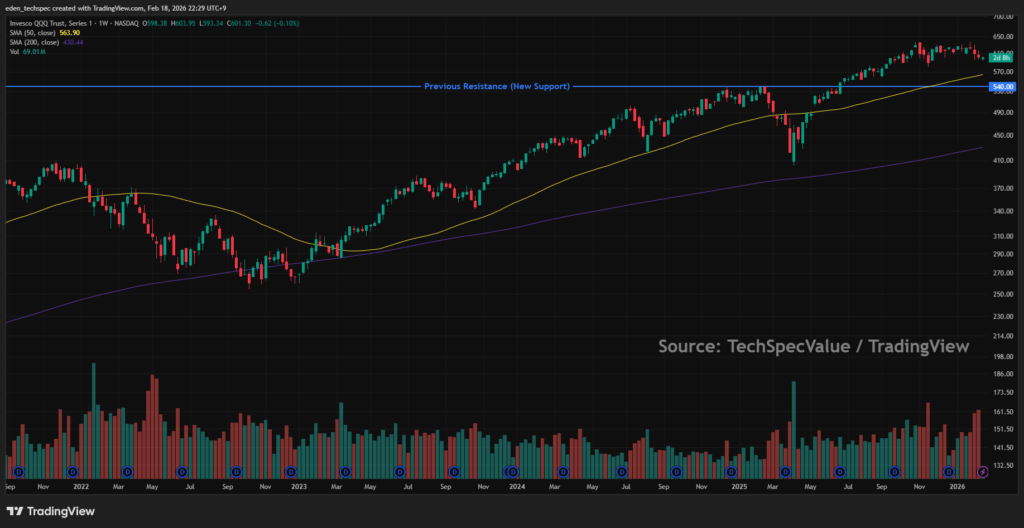
From a rigorous technical analysis perspective, the 2026 Market Outlook is visually manifested by a historic “Breakout and Retest” pattern that is currently dominating the monthly and quarterly charts. For several years, the major equity indices—specifically the QQQ (Nasdaq 100) and the SPY (S&P 500)—were trapped within a volatile, wide-ranging consolidation box, struggling to find a definitive direction amidst macro uncertainty. In early 2026, we witnessed a clean, high-volume breakout above those multi-year resistance levels. In systems engineering, when a structural component moves past its previous stress limit without fracturing, that old limit becomes the new baseline for stability. We are seeing exactly that in the current market geometry. The previous “Resistance” levels, which once acted as a psychological and technical ceiling for stock prices, have now flipped into powerful “Support” zones. Furthermore, the emergence of a “Golden Cross” on the weekly and monthly timeframes—where the 50-period moving average crosses decisively above the 200-period moving average—is a statistically significant “Lagging Confirmation” that the long-term trend has shifted from “Post-Crisis Recovery” to “Systemic Expansion.” This technical confirmation gives institutional quantitative funds and algorithmic traders the signal to increase their “Net Long” exposure, providing even more momentum to the upward trajectory defined in this 2026 Market Outlook.
The Upward Channel: Analyzing the Lows and the Power of Momentum
The most technically encouraging sign in the 2026 Market Outlook landscape is the consistent and methodical formation of “Higher Lows.” This is the undeniable hallmark of a healthy, sustainable, and institutional-led bull market. Unlike the speculative “meme-driven” manias of 2021, which were characterized by vertical, unsustainable spikes followed by immediate crashes, the current move in 2026 is defined by a “Stairstep” progression. Each minor correction or period of profit-taking is met with a higher level of institutional support, creating a rising “Ascending Channel” that remains perfectly intact. This technical structure suggests that the market is “digesting” its gains and allowing valuation fundamentals to catch up with price action, rather than becoming dangerously overextended. The Relative Strength Index (RSI) across major indices remains in a healthy “Bullish Zone” (between 60 and 70), indicating strong momentum without entering the “Extreme Overbought” territory that typically precedes a systemic collapse. This tells us as analysts that there is still significant “Room to Run” before we reach a point of exhaustion. For the 2026 Market Outlook, the technical charts are in perfect synchronization with the macroeconomic fundamentals. The “Chart is the Truth” in this scenario; it is the visual manifestation of a collective global confidence. As the major indices continue to respect these new support levels, the year-end targets for 2026 move progressively higher, reflecting a market that has finally found its footing on solid, data-driven ground.
| Sector Segment | 2024 Focus | 2026 Focus | Growth Driver |
|---|---|---|---|
| Hardware (Semis) | Capacity Buildup | Replacement Cycles | Efficiency & Speed |
| Software (SaaS) | BETA Features | Monetized Agents | Subscription Explosion |
| Cloud Infrastructure | Hyperscale Capex | Margin Optimization | Energy Efficiency |
5. Earning Surprise Season: The Fundamental Triumph
Efficiency Paradigms and the AI-Driven Productivity Revolution
The 2026 Market Outlook is increasingly defined by what I call the “Historic Expansion of the Bottom Line,” a phenomenon where corporate profitability is decoupling from traditional economic constraints. For several years, the narrative surrounding Artificial Intelligence was heavily centered on the massive capital costs required for implementation; however, in the 2026 Market Outlook era, that narrative has shifted entirely toward “Yield Optimization.” As a systems engineer, I recognize that the most profound shifts in any complex ecosystem occur when “Operational Leverage” is perfectly optimized through technological intervention. We are currently witnessing a period where Fortune 500 corporations have successfully trimmed the “legacy fat” from their operational processes and replaced them with high-velocity, autonomous AI workflows. This is not merely a story about labor displacement; it is a fundamental story about augmenting the “Output per Human Hour” to levels that were mathematically impossible just three years ago. During the Q1 2026 earnings season, a recurring and powerful theme emerged: mid-single-digit revenue growth of 8-10% was translating into explosive EPS growth of 15-20% or more. This “Negative Operating Leverage” in reverse is the direct result of a fixed-cost base meeting a hyper-scalable, AI-enhanced revenue model. The “Surprise” in these earnings reports isn’t just a simple beat on the consensus numbers; it is a fundamental shift in how Wall Street analysts must model future cash flows for the 2026 Market Outlook. When a company can produce 30% more output with the same energy and labor input, the intrinsic value of that business must be structurally re-rated.
EPS Guidance and the Death of the “Overvalued” Myth
One of the most persistent and vocal bear-market arguments in recent memory was the claim that the market was “Too Expensive” based on historical P/E (Price-to-Earnings) ratios. However, the 2026 Market Outlook effectively dismantles this myth through the sheer, undeniable force of Earnings Per Share (EPS) growth. As we analyze the forward-looking guidance provided by the S&P 500 leadership, we observe a massive, synchronized upward revision trend that defies historical norms. It is a fundamental truth in stock analysis: a high price is only “Expensive” if the earnings trajectory is stagnant or declining. In the 2026 Market Outlook, the earnings are not just following the price—they are actively leading it. Interestingly, we are seeing “Forward P/E Compression” even as major stock indices hit consecutive record highs, because the denominator (Earnings) is growing faster than the numerator (Price). This suggests that we are currently in a “Fundamental Bull Market,” where price appreciation is backed by actual, audited, dollar-denominated corporate success. The core value proposition here is the disappearance of the “Valuation Gap.” Sophisticated investors are realizing that paying a perceived “premium” for a company with a 25% EPS growth rate and high AI integration is actually a more conservative and prudent strategy than buying a “cheap” value stock with zero growth potential. This realization is fueling a sustained and aggressive rally in blue-chip tech and high-efficiency industrial sectors, proving that in the 2026 Market Outlook, fundamentals always win in the long run.
6. Consumer Confidence: The Engine of Resilience
Real Wage Growth and the Rebirth of Household Purchasing Power
While the technology sector provides the “Flash” and the “Innovation” for the 2026 Market Outlook, the American consumer remains the primary “Fuel” that keeps the entire engine running. This outlook is significantly bolstered by a structural shift in the household balance sheet that has been years in the making. For the first time in nearly a decade, we are experiencing a sustained period where real wage growth is consistently and decisively outpacing the rate of inflation. With the CPI now firmly anchored at 2.4%—a key milestone in our 2026 Market Outlook—the “Purchasing Power” of the average household is finally expanding in real terms. This is a critical component of the “Great Awakening.” When consumers perceive that their monthly paycheck is actually gaining value rather than being eroded by price hikes at the grocery store or gas station, their propensity to spend shifts from “Essential/Defensive” to “Discretionary/Growth.” This shift has triggered a massive “Internal Rotation” within the equity markets. While 2024 and 2025 were characterized by a narrow focus on “Magnificent Seven” tech stocks, the 2026 Market Outlook is defined by a broad-based rally that includes retail, travel, housing, and leisure sectors. The “Consumer Confidence Index” has returned to pre-pandemic highs, not because of temporary government stimulus, but because of a structurally healthy labor market and predictable price stability. As an analyst, I monitor these “Secondary Sectors” as a primary confirmation of the overarching trend; a market where every sector is participating in the upside is a market with deep roots and a much longer “Shelf Life.”
The Wealth Effect and the Virtuous Cycle of Market Growth
Beyond simple wage growth, we must also account for the powerful “Wealth Effect” created by the multi-year surge in equity and real estate markets, which is a centerpiece of the 2026 Market Outlook. By mid-2026, the average American retirement account (401k/IRA) has reached an all-time high, and home equity remains remarkably robust due to a stabilized interest rate environment that has unlocked the “frozen” housing market. This creates a psychological and financial “Safety Net” for the consumer. When individuals see their net worth increasing on paper every month, they are significantly more willing to engage in high-ticket discretionary consumption—such as new automobiles, home renovations, and luxury services. This dynamic creates what we call a “Virtuous Cycle” within the 2026 Market Outlook: robust consumer spending drives corporate revenue growth; increased revenue drives stock prices higher; rising stock prices increase consumer wealth; and the cycle repeats with increasing velocity. This is the solid “Economic Foundation” that supports the “Technical Breakout” patterns discussed in earlier parts of this analysis. The 2026 Market Outlook is not just a speculative bubble built on hype; it is a clear reflection of a society and an economy that has moved past the era of post-pandemic scarcity and into a new era of renewed abundance and technological productivity. The stability of macro-data combined with the undeniable strength of consumer micro-data suggests that the global economic engine is running at peak efficiency.
| Ticker | Previous Resistance | 2026 Current Support | Technical Signal |
|---|---|---|---|
| SPY (S&P 500) | Breakout Level | New Baseline | Bullish Trend |
| QQQ (Nasdaq 100) | All-Time High (Old) | Psychological Floor | Golden Cross |
| IWM (Small Cap) | Multi-Year Box | Rising Trendline | Catch-up Trade |
7. Harvesting Returns: The Realization of Wealth
The Power of Patience and the Manifestation of the Compound Effect
The 2026 Market Outlook reaches its strategic and emotional apex in the concept of “Harvesting.” For the disciplined investor who maintained their composure during the turbulent years of 2022 and 2023, the current market environment is the literal “Fruit” of seeds planted in a season of extreme uncertainty. As a systems engineer, I compare this phase to a “Steady State” operation in a complex machine—where the massive initial energy required to overcome friction and start the engine is no longer needed, and the system now generates significantly more output than the energy input required to maintain it. We are seeing the “Compounding Effect” transition from a theoretical mathematical exercise in a textbook into a tangible, life-changing reality. Portfolios that remained consistently invested in high-quality indices or specialized dividend growth strategies are now experiencing “Step-Function” jumps in total Net Asset Value (NAV). This is the “Great Awakening” of the individual balance sheet within the 2026 Market Outlook framework. The value of patience is no longer just a philosophical suggestion for long-term holders; it has become a quantified, audited line item in their brokerage statements. In this era, the primary risk to wealth is no longer market volatility, which has been dampened by CPI stability, but “Opportunity Cost”—the permanent financial cost of sitting on the sidelines while the most powerful, technology-driven bull market of the decade accelerates toward its multi-year targets.
Strategic Rebalancing and the Long-Term Vision for 2027 and Beyond
As we harvest these returns, the 2026 Market Outlook demands a sophisticated shift from “Aggressive Accumulation” to “Strategic Capital Management.” This is the precise moment where the “Smart Money” begins to rebalance, not out of a sense of fear or market timing, but out of a commitment to engineering precision. By systematically locking in gains from high-flying, parabolic AI sectors and rotating that capital into “Value” areas or increasing positions in “Dividend Aristocrats,” investors are building what I call a “Fortress Portfolio.” This proactive strategy ensures that the massive gains achieved during this 2026 Market Outlook “Great Awakening” are preserved and protected for the next economic cycle. The ultimate value here is the creation of a perpetual income machine. As the “Yield on Cost” improves for long-term holders, the dividend distributions alone begin to cover essential living expenses, marking the true “Financial Independence” that the stock market has always promised but only the disciplined achieve. Looking ahead, the structural tailwinds identified in this 2026 Market Outlook—including CPI 2.4% stability, unprecedented AI efficiency, and the Fed’s monetary ease—provide a clear, high-visibility runway for 2027 and beyond. The “Final Note” for any serious analyst is this: the market consistently rewards those who view it as a marathon of data and logic, not a sprint of emotion and hype. By following this roadmap, you are not just “trading” price action; you are “engineering” a future of sustainable, compounding prosperity.
Further Reading (External)
- U.S. Bureau of Labor Statistics: Consumer Price Index Summary
- Federal Reserve: Monetary Policy Reports
- NVIDIA Investor Relations: Data Center Growth Analysis